
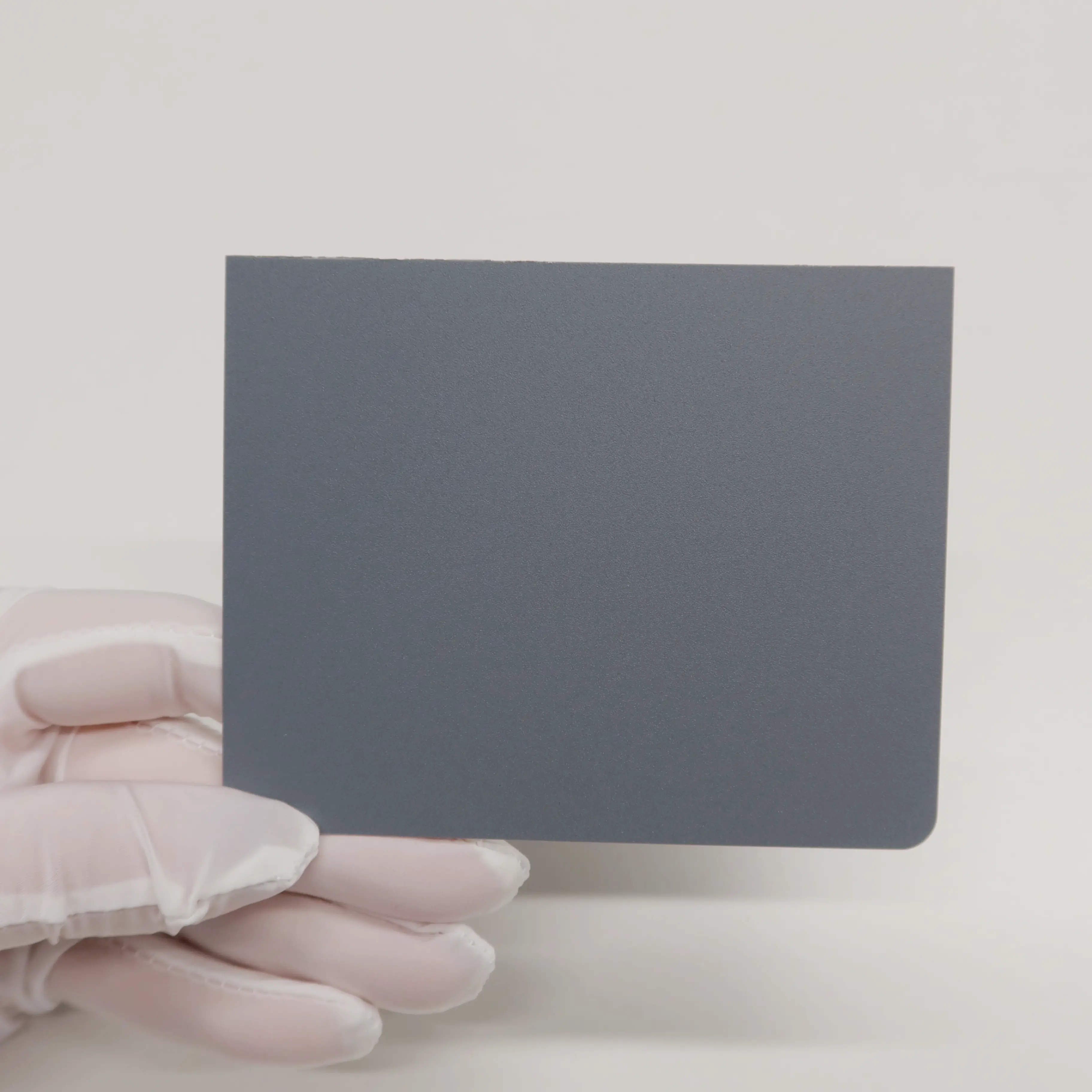
Diffuse Reflectance Standards play an essential role in modern optical engineering—from automotive LiDAR and machine vision systems to spectroscopy, robotics, and industrial imaging. As sensing technologies evolve, demand for accurate, stable, and reliable reflectance reference panels continues to grow.
In this article, we break down what diffuse reflectance standards are, how they work, where they are used, and what specifications truly matter when choosing the right calibration target.
What Are Diffuse Reflectance Standards?
Diffuse Reflectance Standards are specialized panels designed to provide stable, angle-independent diffuse reflection, typically following Lambertian cosine distribution. They are used to calibrate and validate optical systems, ensuring that reflectance measurements remain accurate over time and across different environments.
Unlike glossy or specular surfaces, diffuse reflectance standards scatter incoming light evenly in all directions. This uniform scattering makes them ideal for validating LiDAR sensors, camera exposure systems, and high-precision optical instruments.
Why Diffuse Reflectance Standards Matter in Modern Optical Systems
With rapid advancements in robotics, ADAS, autonomous vehicles, and industrial inspection, optical sensors are expected to perform reliably in a wide range of lighting and reflectivity conditions. Diffuse reflectance standards offer:
-
Repeatable and traceable reflectance values
-
Stable calibration benchmarks across wavelengths
-
Controlled test environments for performance comparison
-
Consistent Lambertian behavior required in measurement standards
Whether you're developing a long-range LiDAR or a high-dynamic-range camera, these reference targets form the backbone of objective, repeatable optical performance testing.
Key Specifications to Consider
When selecting a diffuse reflectance standard, engineers typically evaluate the following attributes:
-
Reflectance Level (1%–99%)
Different optical applications require different reflectance values.
Popular options include:
-
Low reflectance: 2%, 10% → Used for long-range LiDAR threshold detection
-
Mid reflectance: 40%–60% → Ideal for general-purpose camera calibration
-
High reflectance: 90%–99% → Used in albedo studies, photometry, and spectrometry
Custom reflectance values are increasingly common, especially for ADAS development.
-
Wavelength Range (UV–VIS–NIR)
Advanced reflectance standards cover 200–2000 nm, supporting:
-
UV spectroscopy
-
Visible light imaging
-
Near-infrared LiDAR (850 nm / 885 nm / 940 nm / 1550 nm)
Ensuring uniform spectral response is essential for cross-wavelength calibration.
-
Lambertian Performance
High-quality reflectance targets must demonstrate:
-
Cosine-law scattering
-
Minimal directional bias
-
Stable reflectance across observation angles
This ensures that tests performed in one environment remain reproducible in another.
-
Material Durability and Coating
The best reflectance standards use:
-
Matte, non-glossy surfaces
-
Special-ink or engineered coatings
-
Chemically inert and long-lasting materials
Durability is especially important for outdoor LiDAR testing and large-scale industrial deployments.
-
Size & Customization
Modern test environments often require large or unusual sizes:
-
Standard sizes: A6, A5, A4, A3
-
Custom panels up to 3 × 5 meters
-
Fully adjustable mounting systems
-
Weatherproof and dustproof options
This adaptability makes the standards suitable for anything from lab setups to automotive proving grounds.
How Diffuse Reflectance Standards Are Used in Real-World Applications
Autonomous Driving & Long-Distance LiDAR
Used to validate detection range, reflection intensity, and environmental robustness for 850/885/940/1100 nm LiDAR systems.
Machine Vision & Camera Calibration
Ideal for verifying exposure curves, dynamic range, color accuracy, and white balance.
Robotics & Indoor Navigation
Robotic vacuum cleaners, SLAM systems, and industrial automation rely on reflectance references for mapping and positioning.
Spectroscopy & Research Labs
Used as baseline materials in UV–VIS–NIR measurement and material characterization.
Product Quality Control
Manufacturers use reflectance targets to ensure consistency in coatings, paints, plastics, and surface treatments.
Why Oklab Diffuse Reflectance Standards Stand Out
OKLAB provides industry-grade diffuse reflectance standards engineered specifically for modern optical testing:
-
1–99% customizable reflectance
-
Uniform spectral response across 200–2000 nm
-
Excellent Lambertian scattering properties
-
Custom sizes up to 3 × 5 m
-
Optional waterproof and outdoor-ready designs
-
Accessories including brackets, sliders, and aluminum boxes
-
Designed for automotive LiDAR, robotics, camera systems, and lab applications
Each panel undergoes optical verification to ensure consistency, accuracy, and long-term stability.
Final Thoughts
Diffuse Reflectance Standards are an indispensable tool for optical engineering. As sensing technologies move toward higher resolution, longer range, and more complex environments, the need for reliable reflectance references has never been greater.
Whether you're designing a LiDAR perception system, calibrating a machine vision camera, or conducting NIR spectroscopy, high-quality reflectance targets ensure that your measurements remain accurate, repeatable, and scientifically meaningful.
If you’re looking for customizable, industrial-grade diffuse reflectance standards, OKLAB delivers precision-engineered solutions tailored to your application needs.