
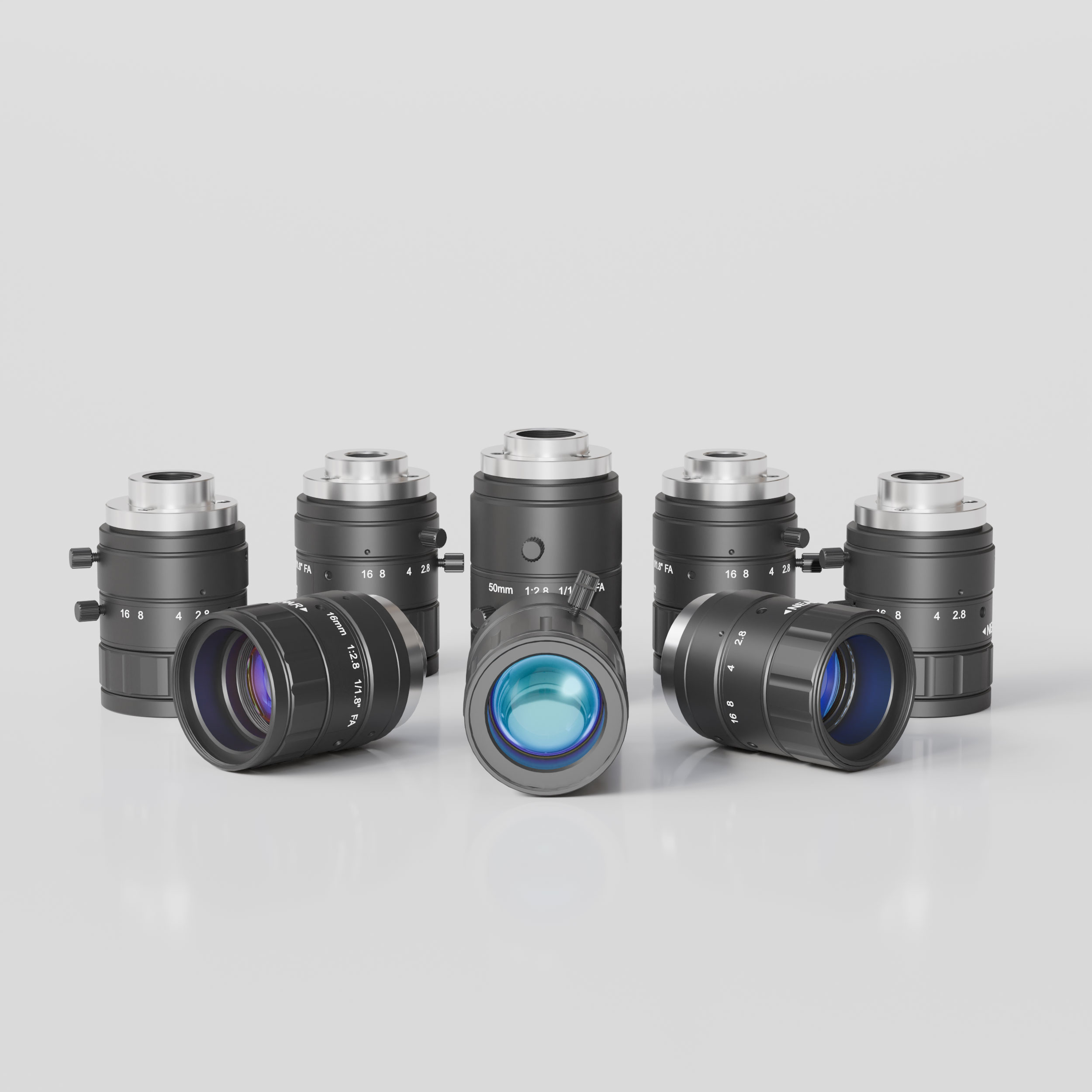
When choosing a Fixed Focal Length Lens, follow this general sequence:
Application Requirements → Focal Length and Sensor Coverage → Image Performance → Mechanical Compatibility → Product Selection
Start by defining the actual inspection conditions of the machine vision system. Then determine the optical and mechanical specifications the lens must meet, and finally use those requirements to select a suitable Fixed Focal Length Lens.
1. Define the Machine Vision Application Requirements
Lens selection starts with Field of View, Object Size, Working Distance, and Minimum Inspection Feature. These conditions define the inspection area, installation distance, and smallest detail the machine vision system must detect.
① Field of View and Object Size
The required field of view should be determined from the object and actual inspection area.
• Field of View: Confirm the actual width and height that must be covered in a single image.
• Object Size: Confirm the physical size of the object and determine how much of the image should be occupied by the full object or the key inspection area.
② Working Distance
Working Distance should be determined from the actual equipment installation conditions.
• Installation Distance: Confirm the available distance between the Camera and the object.
• Fixed Working Position: For a fixed Machine Vision System, determine the Lens-to-object distance at the normal operating position.
③ Minimum Inspection Feature
Minimum Inspection Feature defines the smallest real detail the system must detect.
• Defect Size: Confirm the smallest scratch, chip, stain, or other defect that must be detected.
• Character and Edge Size: Confirm the smallest character, edge, or line that must be recognized.
• Surface Detail: Confirm the smallest surface texture or structural detail that must be visible.
2. Choose the Right Focal Length and Sensor Coverage
This step determines the required focal length of the Fixed Focal Length Lens and whether the lens can fully cover the Camera Sensor.
① Focal Length
Focal length selection mainly depends on three conditions:
• Field of View: With the same Sensor Size and Working Distance, a larger FOV generally requires a shorter Focal Length.
• Working Distance: With the same FOV and Sensor Size, a longer Working Distance generally requires a longer Focal Length.
• Sensor Size: Different Sensor Sizes produce different Fields of View when the same focal length is used.
② Sensor Coverage
Sensor Coverage is mainly evaluated using the following three parameters:
• Sensor Format: Confirm the actual Sensor Size and Format used by the Camera.
• Supported Sensor Format: Confirm the maximum Sensor Format supported by the Fixed Focal Length Lens.
• Image Circle: Confirm that the effective image circle produced by the Lens covers the entire Camera Sensor Area.
3. Match Lens Imaging Performance to the Inspection Task
This step confirms whether Lens Resolution, Aperture, Depth of Field, and Distortion can meet the requirements of the machine vision inspection task.
① Lens Resolution
Lens Resolution should be determined according to the resolving capability of the Camera Sensor.
• Camera Resolution: Confirm the image resolution and total pixel count of the Camera. A higher Camera Resolution requires greater detail resolution from the Lens.
• Pixel Size: Confirm the physical size of each Sensor Pixel. Smaller Pixels require the Lens to reproduce finer image detail.
• Lens Resolution: Confirm that the Lens provides sufficient resolving power to project the required object details clearly onto the Sensor.
② Aperture and Depth of Field
Aperture and Depth of Field should be selected according to lighting conditions and variations in object height.
• Aperture: A larger Aperture allows more light into the system and is suitable for applications requiring greater image brightness or shorter Exposure Time.
• Depth of Field: Confirm the actual depth range over which the object must remain acceptably sharp.
• Object Height Variation: When the object contains different height levels, the DOF should cover all areas that need to be inspected.
③ Distortion
Distortion requirements are mainly determined by the geometric accuracy required by the machine vision task.
• Measurement: Dimensional measurement requires low Distortion to reduce size errors caused by different image positions.
• Positioning: High-precision positioning requires control of geometric displacement across different areas of the image.
• Edge Detection: Contour and edge inspection requires stable object shape and edge position.
4. Confirm Lens Mount and Mechanical Compatibility
This step confirms whether the Lens Mount, Adapter, Lens Size, and available installation space are compatible with the Camera and machine vision equipment.
① Lens Mount
The Lens Mount must match the Camera interface.
• C-Mount: Commonly used with industrial Cameras and Machine Vision Lenses.
• CS-Mount: Uses the corresponding CS-Mount interface and flange distance specification.
• Other Mounts: Other industrial Camera interfaces should use a Lens that matches the actual Camera Mount Specification.
② Adapter Compatibility
When the Camera Mount and Lens Mount are different, confirm whether an Adapter can be used to connect them.
• Camera Mount: Confirm the interface currently used by the Camera.
• Lens Mount: Confirm the mount used by the Fixed Focal Length Lens.
• Adapter Type: Select an Adapter that matches both the Camera and Lens interfaces.
• Flange Distance: Confirm that the required flange distance is maintained after the Adapter is installed.
For related mount conversion applications, see the CS-C Mount Adaptor Ring for Machine Vision Lens.
③ Lens Size and Installation Space
The mechanical dimensions of the Lens must fit the available equipment space.
• Lens Diameter: Confirm that there is sufficient clearance between the Lens and Lighting, Brackets, or other mechanical structures.
• Lens Length: Confirm that the total installed Lens length fits the equipment structure.
• Adjustment Space: Leave enough operating space for Focus and Aperture adjustment mechanisms.
• Surrounding Components: Confirm that Camera Cables, Lighting, and mounting brackets do not interfere with Lens installation.
5. Compare Fixed Focal Length Lens Products Based on the Selection Parameters
After confirming the application conditions, optical requirements, and mechanical compatibility, compare specific Fixed Focal Length Lens products using the required specifications.
• Focal Length Range: Confirm that the product series includes the required fixed focal length.
• Supported Sensor Format: Confirm that the Lens can fully cover the actual Camera Sensor.
• Resolution Compatibility: Confirm that the Lens Resolution matches the Camera Resolution and Pixel Size.
• Mount Type: Confirm that the Lens Mount matches the Camera interface or can be connected using a suitable Adapter.
• Mechanical Dimensions: Confirm that the Lens Diameter, Lens Length, and adjustment structure fit the available installation space.
These parameters can be used to compare: