
Introduction: The Limitations of Standard Test Targets
In the world of optical testing and camera calibration, the USAF 1951 resolution test chart has been the gold standard for decades. Originally developed by the United States Air Force in 1951, this pattern has become ubiquitous in laboratories, manufacturing facilities, and research institutions worldwide.
But here's the problem: standard test targets are designed for standard tests.
When your testing requirements go beyond basic resolution measurements—when you need to evaluate spatial frequency response (SFR), assess field uniformity across multiple points, or characterize lens performance at various positions—a single, off-the-shelf USAF 1951 chart simply isn't enough.
That's where custom-designed test targets come in.
In this article, we'll explore why custom USAF 1951 arrays are becoming essential for modern optical testing, how intelligent design features can streamline your workflow, and what to consider when specifying a custom calibration target for your application.
The Evolution of Optical Testing Requirements
From Single-Point to Multi-Point Analysis
Traditional optical testing typically involved:
- Placing a single USAF 1951 chart at the center of the field
- Capturing an image
- Measuring resolution at that one point
This approach worked fine for simple lens evaluation, but modern applications demand more:
Smartphone cameras require edge-to-edge sharpness
Automotive vision systems need consistent performance across wide fields of view
Machine vision applications depend on uniform resolution throughout the imaging area
Cinema lenses must maintain optical quality from center to corner
The solution? Multi-point testing with strategically positioned resolution targets.
Case Study: OKLab's Custom 9-Pattern USAF 1951 Array
Let's examine a real-world example of intelligent custom target design.
Design Overview
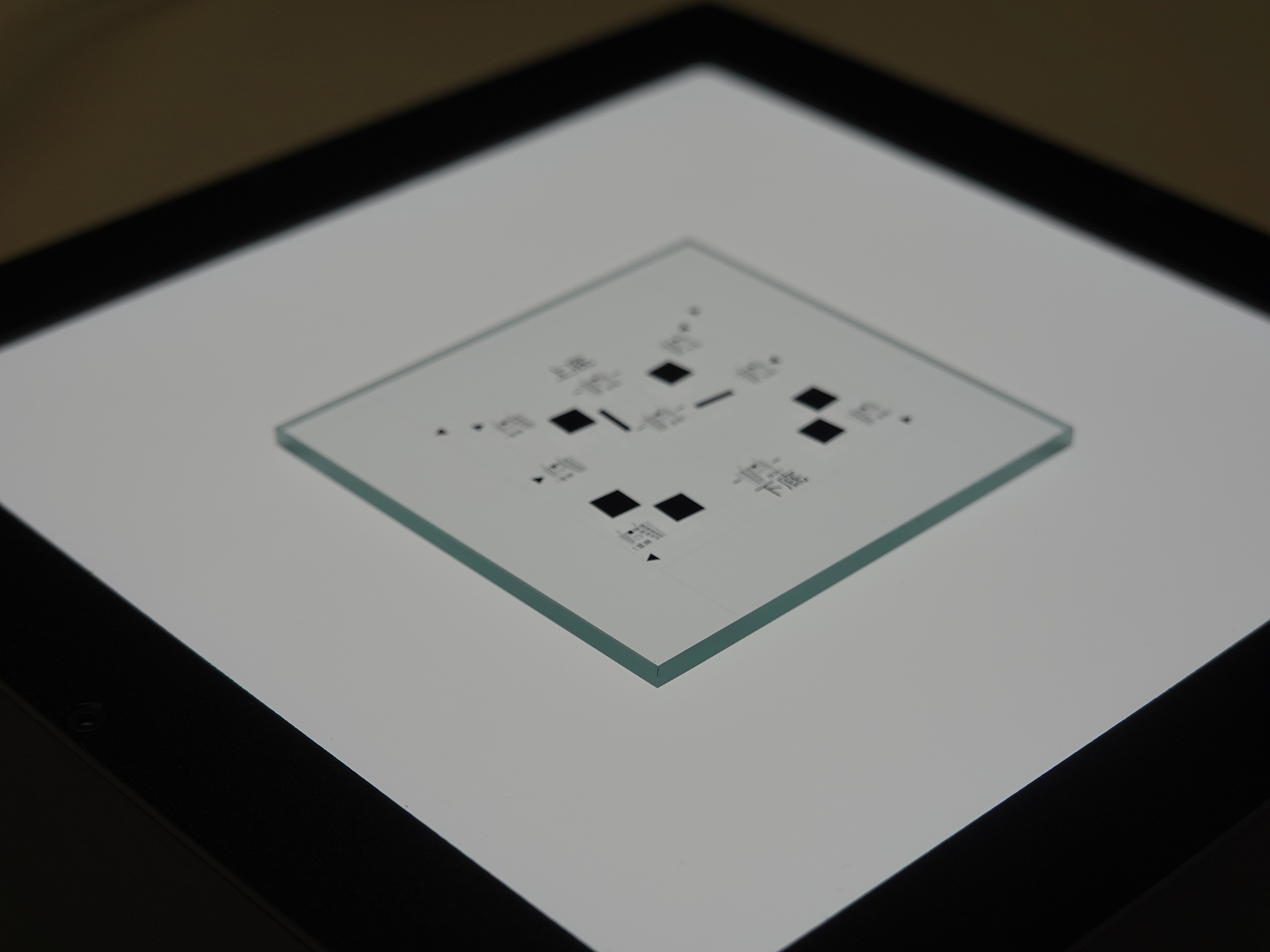
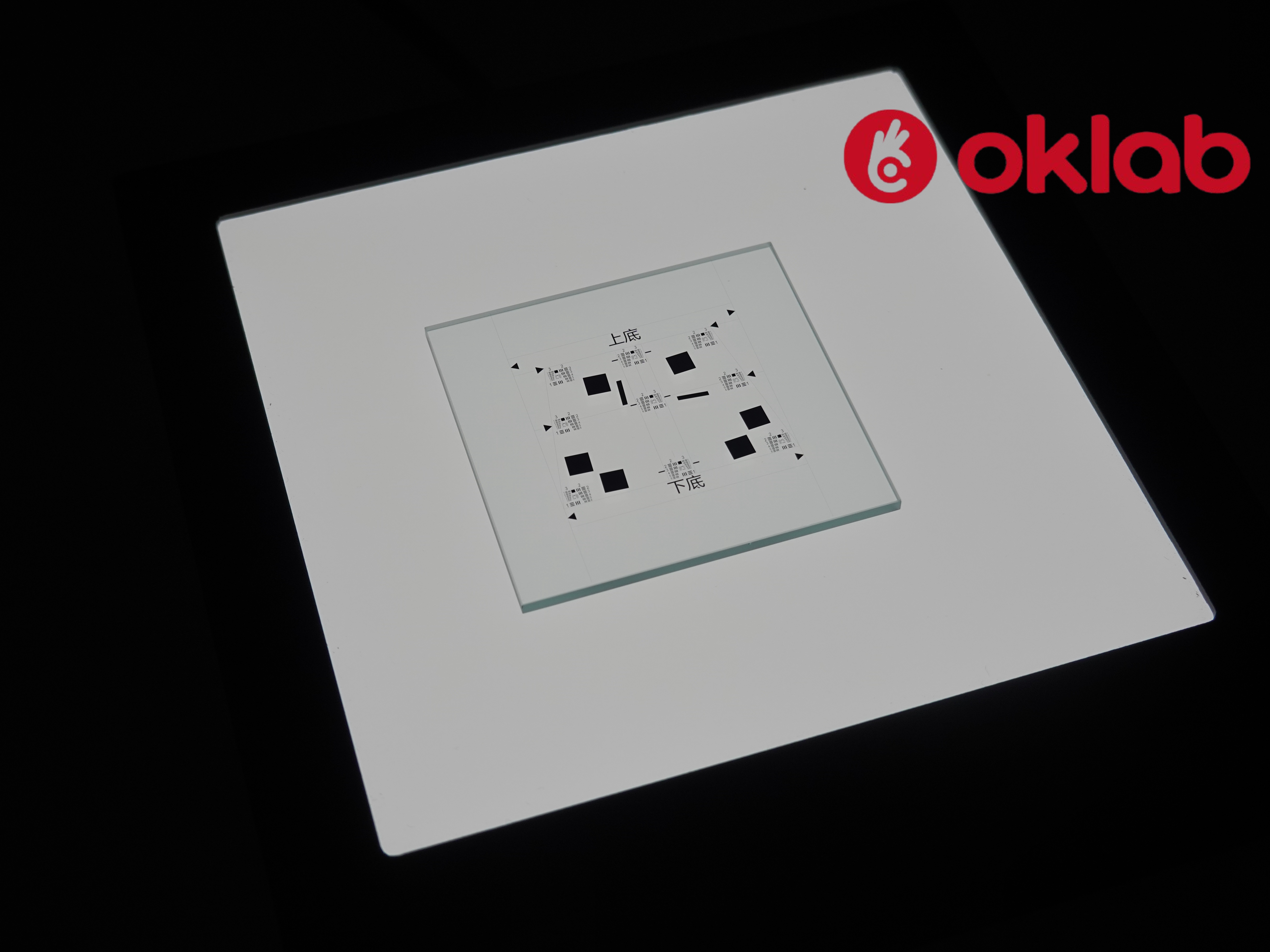
OKLab recently developed a custom USAF 1951 test target featuring:
- 9 USAF 1951 patterns arranged across the field
- Triangle markers for positioning and alignment
- Square blocks for SFR (Spatial Frequency Response) measurements
- Chrome-on-glass construction for durability and precision
Why This Design Works
1. Comprehensive Field Coverage
Nine strategically positioned USAF 1951 patterns allow simultaneous testing of:
- Center performance (critical for most lenses)
- Mid-field zones (where many lenses show performance drop-off)
- Corner regions (the most challenging areas for optical systems)
Instead of repositioning a single target nine times, engineers can capture one image and extract data from all nine positions simultaneously.
Time saved: What used to take 30-45 minutes now takes 5 minutes.
2. Intelligent Positioning Markers
The triangle markers serve multiple purposes:
✓ Alignment verification – Ensure the target is perpendicular to the optical axis
✓ Distortion measurement – Triangles at known positions reveal geometric distortion
✓ Automated detection – Software can easily identify triangular features for automated analysis
✓ Rotation reference – Clear indication of target orientation
In automated testing systems, these positioning markers enable:
- Rapid target detection
- Precise image registration
- Automated pass/fail criteria
- Consistent test-to-test repeatability
3. Dedicated SFR Measurement Zones
The square blocks are specifically designed for Spatial Frequency Response (SFR) analysis:
What is SFR?
SFR (also called MTF - Modulation Transfer Function) measures how well an optical system reproduces contrast at different spatial frequencies. It's a more comprehensive measure of image quality than simple resolution numbers.
Why squares?
- Sharp, well-defined edges in horizontal and vertical orientations
- Consistent contrast ratio for reliable measurements
- Large enough for accurate edge spread function (ESF) analysis
- Compatible with industry-standard SFR measurement software (Imatest, Image Science Associates tools, etc.)
The advantage:
While USAF 1951 patterns excel at resolution testing, they're not optimal for SFR analysis. By including dedicated square blocks, this custom target enables:
- Resolution testing (via USAF patterns)
- SFR/MTF analysis (via square edges)
- All from a single image capture
Material Matters: Chrome on Glass vs. Alternatives
Why Chrome on Glass?
OKlab manufactures this custom target using chrome-on-glass technology:
Advantages:
✅ Exceptional durability – Resistant to scratches, cleaning, and handling
✅ Dimensional stability – Glass doesn't warp or deform over time
✅ Precise edges – Photolithographic process creates sharp, clean boundaries
✅ High contrast – Chrome provides excellent opacity
✅ Long lifespan – 10+ years with proper care
✅ Consistent optical properties – No fading or degradation
Comparison with alternatives:
| Min. Feature Size (Required Accuracy) |
Manufacturing Process | Coating Type | Features | Substrate Recommended | |
| ≥ 0.5μm (±1μm) | Laser Writing | Silver Chrome | High Reflectivity | Blue Chrome (Low Reflectivity, OD>4.5) | Glass/Ceramic |
| Brown Chrome | Moderate Reflectivity | Blue Chrome (Low Reflectivity, OD>4.5) | |||
| Blue Chrome | Low Reflectivity, OD>4.5 | ||||
| ≥ 20μm (±2μm) | Photosensitive Ink | Black Coating | Non-reflective, OD>5.0 | Glass/Carbon Fiber/White PE on Glass | |
| ≥ 15μm (±10μm) | Laser Drawing | Silver Bromide | 100% Black OD>4.5, Grayscale OD Controllable | Film | |
| ≥ 0.3mm (±0.1mm) | Inkjet | Ink | High Contrast | Photo Paper |
For production environments and applications requiring long-term reliability, chrome-on-glass is the optimal choice.
Applications: Where Custom USAF Arrays Excel
1. Lens Manufacturing QC
Camera lens manufacturers use multi-point USAF arrays to:
- Test production lenses rapidly
- Verify field uniformity
- Catch decentering or assembly errors
- Generate pass/fail reports automatically
Example workflow:
- Position lens in test fixture
- Capture single image of 9-point USAF array
- Automated software analyzes all 9 positions
- Generate QC report in <30 seconds
2. Smartphone Camera Module Testing
Mobile device manufacturers require:
- Edge-to-edge sharpness verification
- Wide-angle lens characterization
- Multi-camera array alignment
- High-volume testing throughput
Challenge: Testing each camera at 9 field positions with separate targets would create bottlenecks.
Solution: Single custom array enables complete characterization in one capture.
3. Automotive Vision Systems
ADAS (Advanced Driver Assistance Systems) cameras demand:
- Consistent performance across 100°+ fields of view
- Resolution verification at critical zones (lane markers, signs, pedestrians)
- Distortion measurement
- High reliability standards
Custom USAF arrays can be designed with:
- Pattern placement matching critical field positions
- Larger patterns for wide-angle testing
- Additional markers for distortion analysis
4. Cinema and Broadcast Lenses
Professional cinematography requires:
- Corner-to-corner sharpness
- Consistent performance at different focus distances
- Resolution verification across zoom ranges
Custom solution: Multiple USAF arrays at different sizes, allowing testing at various focus settings without changing targets.
5. Research and Development
Optical engineers developing new imaging systems benefit from:
- Flexible testing configurations
- Rapid iteration during prototyping
- Multi-parameter evaluation
- Documentation of performance evolution
Designing Your Custom Test Target: Key Considerations
If you're considering a custom USAF 1951 array for your application, here are the critical factors to evaluate:
1. Field Coverage Requirements
Questions to ask:
- How many test points do you need?
- Which field positions are most critical for your application?
- Do you need center-weighted or uniform distribution?
Common configurations:
- 5-point: Center + 4 corners (simple, fast)
- 9-point: Center + mid-field + corners (comprehensive)
- 13-point: Dense coverage for demanding applications
- Custom: Asymmetric patterns for specialized needs
2. Pattern Size Selection
USAF 1951 patterns come in different "group" sizes. Consider:
Sensor resolution:
- High-resolution sensors (>20MP) → Smaller groups (5-7)
- Medium resolution (10-20MP) → Groups 0-5
- Lower resolution or wide-angle → Groups -2 to 3
Working distance:
- Close-up testing → Smaller patterns
- Long-distance testing → Larger patterns
Tip: Include multiple group sizes on the same target for flexibility.
3. Additional Features
Consider adding:
Positioning markers:
- Triangles (easy automated detection)
- Crosses (precise center marking)
- Circles (distortion analysis)
- Coded markers (automated target identification)
SFR zones:
- Slanted edges (ISO 12233-compliant SFR)
- Square blocks (simplified SFR)
- Checkerboard patterns (multiple edge orientations)
Color patches:
- Neutral gray (white balance verification)
- Color checker (color accuracy)
- Multiple gray levels (tonal response)
4. Substrate and Size
Material options:
- Chrome on glass: Production use, high durability
- Photo paper: R&D, cost-effective
- Quartz glass: High-precision applications
- Ceramic: Extreme environments
- Film: Backlit/transmission testing
Physical size:
- Must fill appropriate portion of your field of view
- Consider working distance and lens focal length
- Account for mounting and handling
- Balance between detail and practicality
5. Illumination Compatibility
Front (reflective) illumination:
- Chrome on glass: Excellent
- Photo paper: Good (matte finish preferred)
Back (transmission) illumination:
- Glass with chrome: Excellent
- Film: Excellent
- Photo paper: Not suitable
The Design Process: From Concept to Delivery
Step 1: Requirements Gathering
Working with OKLab's engineering team, define:
- Application and testing goals
- Camera/lens specifications
- Working distance and field of view
- Throughput requirements
- Budget constraints
Step 2: Design Proposal
OKLab provides:
- CAD rendering of proposed layout
- Pattern size calculations
- Material recommendations
- Cost estimate
- Lead time projection
Step 3: Prototype (Optional)
For complex or high-volume applications:
- Photo paper prototype for layout verification
- Testing and iteration
- Final approval before glass production
Step 4: Manufacturing
Chrome-on-glass production:
- Photolithographic masking
- Precision chrome deposition
- Quality control inspection
- Dimensional verification
Step 5: Validation
Before shipping, OKLab:
- Tests each target in conditions matching your application
- Verifies pattern accuracy and uniformity
- Confirms dimensional specifications
- Photographs for documentation
"Tested twice, shipped once" – OKLab's quality commitment.
Step 6: Delivery and Support
Complete package includes:
- Custom test target in protective case
- Technical specification sheet
- Setup and usage recommendations
- Ongoing technical support
Real-World Success Stories
Case Study 1: Smartphone Manufacturer
Challenge: Testing 1,000+ camera modules per day, requiring 5-point field uniformity verification.
Solution: Custom 5-point USAF array with positioning markers for automated handling.
Results:
- Testing time reduced from 8 minutes to 90 seconds per module
- Throughput increased by 5.3×
- Labor costs reduced by 80%
- Payback in 3 days of production
Case Study 2: Industrial Lens QC
Challenge: Incoming inspection of telephoto lenses, verifying center and edge sharpness.
Solution: Custom 9-point array with multiple USAF group sizes.
Results:
- Single-capture testing replaced 3-position sequential testing
- Inspection time: 12 minutes → 4 minutes
- More comprehensive data (9 points vs. 3)
- Improved defect detection rate
Case Study 3: Automotive Camera Validation
Challenge: Wide-angle ADAS camera testing across 120° field of view.
Solution: Large-format custom array with patterns sized for 3m working distance.
Results:
- Complete field characterization in one test
- Distortion mapping via positioning markers
- Regulatory compliance documentation simplified
- Test consistency improved (eliminated repositioning errors)
Common Questions About Custom Test Targets
Q: How long does custom design and manufacturing take?
A: Typical timeline:
- Design consultation: 1-3 days
- Design approval: 1-2 days
- Chrome-on-glass manufacturing: 3-5 days
- Testing and shipping: 2-3 days
- Total: 1-2 weeks
Rush service available for urgent needs.
Q: Can I modify an existing design later?
A: Yes, we maintain CAD files for all custom targets. Modifications (adding patterns, changing sizes, etc.) are straightforward and avoid the full design fee.
Q: What if I'm not sure what I need?
A: OKLab's engineering team provides free consultation. Share your:
- Application description
- Camera/lens specifications
- Testing goals
We'll recommend an optimal configuration.
Q: Do you offer prototypes?
A: Yes. For complex designs, we can produce a photo paper prototype first (~$100, 3-5 days) for layout verification before committing to glass production.
Q: What's the lifespan of a chrome-on-glass target?
A: With proper care: 10-20 years. Chrome-on-glass targets in production environments have been in continuous use for over 15 years.
Q: Can you match our existing test procedures?
A: Absolutely. We can replicate existing target layouts or integrate specific patterns from your current workflow into a unified custom design.
Beyond USAF 1951: Other Custom Calibration Solutions
While this article focuses on USAF 1951 arrays, OKLab designs custom solutions for many applications:
ISO 12233 Resolution Charts
- Slanted-edge SFR patterns
- Custom field layouts
- Combined resolution + color targets
Checkerboard Patterns
- Camera calibration (OpenCV, MATLAB)
- Stereo vision setup
- Robot vision alignment
Halcon-Compatible Targets
- Dot arrays for calibration
- Custom point configurations
- Multi-scale patterns
Color Calibration Charts
- Custom color patch arrangements
- Specialized illuminants
- Metameric test patterns
Hybrid Designs
- Combined resolution + color + geometry
- Multi-function test targets
- Application-specific solutions
Technical Resources and Standards
Relevant Standards:
USAF 1951:
- MIL-STD-150A (original specification)
- Modern interpretations and variations
ISO 12233:
- Digital camera resolution measurement
- SFR/MTF testing methodology
IEEE P2020:
- Automotive imaging quality standards
ISO 15739:
- Digital camera noise measurements
Getting Started with Your Custom Target
Step 1: Assess Your Needs
Ask yourself:
- What are we actually testing?
- Where do we need the most data?
- What's our bottleneck in current testing?
- How will we analyze the results?
Step 2: Contact OKLab
Reach out with:
- Application description
- Camera/lens specs
- Desired outcomes
- Timeline and budget
📧 Email: service@oklab.com
🌐 Browse standard options: https://www.oklab.com/products/usaf1951-test-targets
Step 3: Collaborate on Design
Work with our engineering team to:
- Refine requirements
- Review proposed layouts
- Select materials
- Approve final design
Step 4: Validate and Integrate
When your custom target arrives:
- Verify against specifications
- Integrate into test procedures
- Develop automated analysis (if applicable)
- Document baselines
Step 5: Optimize and Iterate
Based on experience:
- Identify improvements
- Consider additional features
- Plan future designs
Conclusion: The Future of Optical Testing
As imaging technology advances—higher resolutions, wider fields of view, computational photography, multi-camera arrays—testing requirements grow more complex.
Standard test targets have their place, but they represent a one-size-fits-all approach in an era of specialization.
Custom-designed test targets offer:
- Efficiency: Test more parameters in less time
- Accuracy: Optimized for your specific application
- Automation: Enable high-throughput systems
- Insight: Comprehensive data from single captures
- ROI: Rapid payback through time savings
The 9-pattern USAF 1951 array discussed in this article is just one example of how intelligent custom design can transform testing workflows. Whether you need multi-point resolution analysis, combined SFR measurement, or specialized patterns for unique applications, custom test targets deliver better data, faster.
The question isn't whether you can afford a custom test target.
The question is: can you afford not to?
Take the Next Step
Ready to explore custom calibration solutions for your application?
📧 Contact OKLab: service@oklab.com
🛒 Shop standard targets: https://www.oklab.com/products/usaf1951-test-targets
📞 Schedule a consultation: Discuss your testing challenges with our engineering team
OKLab - Precision Vision Solutions for Demanding Applications
About OKLab
OKLab specializes in precision optical test targets and calibration solutions for machine vision, camera manufacturing, and imaging research. From standard USAF 1951 charts to complex custom designs, we deliver the tools you need for accurate, repeatable optical testing.
Our commitment: Every target is tested and validated before shipping—because your precision matters to us.
Keywords: USAF 1951, custom test target, optical testing, MTF testing, SFR measurement, camera calibration, resolution chart, chrome on glass, machine vision, lens testing, multi-point testing, field uniformity, spatial frequency response