
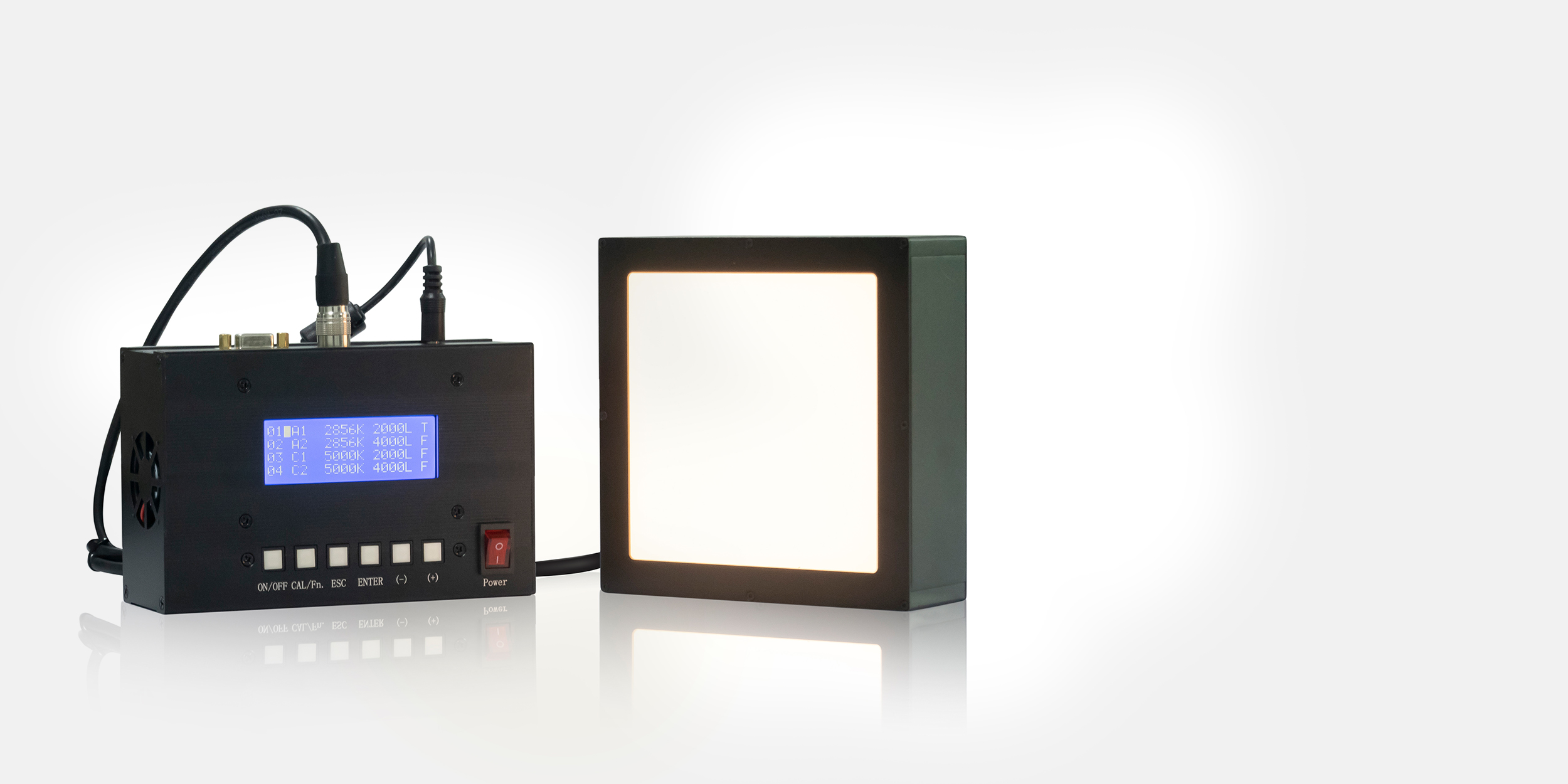
What is a Full-Spectrum Light Source?
A full-spectrum light source is an artificial lighting system that replicates the complete visible light spectrum of natural sunlight, typically ranging from 380nm to 780nm wavelengths. Unlike conventional lighting that emphasizes certain wavelengths while lacking others, full-spectrum sources provide balanced energy distribution across all visible colors.
Quick Definition Box (Featured Snippet Optimized)
Full-Spectrum Light Source: An illumination system that reproduces the continuous spectral distribution of natural daylight with >95% color rendering index (CRI), uniform intensity distribution, and stable color temperature—essential for applications requiring accurate color reproduction and precise optical measurements.
Why Natural Daylight Matters
Natural sunlight represents the gold standard for illumination because:
- Complete spectral coverage: Continuous energy across all visible wavelengths
- Balanced distribution: No harsh peaks or valleys in spectral output
- Color accuracy benchmark: The reference standard (CRI 100) against which all artificial lighting is measured
- Universal compatibility: Works with all camera sensors and human vision equally well
In professional environments—from machine vision systems to color-critical inspection—replicating these characteristics isn't just preferable, it's essential.
The Science Behind Daylight Simulation Technology
Understanding the Solar Spectrum
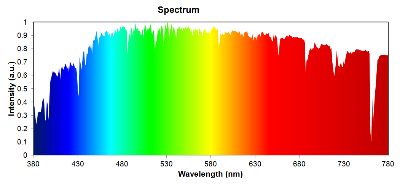
Natural sunlight produces what physicists call a "continuous spectrum" or "blackbody radiation" at approximately 5,800K color temperature. This creates:
Spectral Characteristics:
- Smooth, continuous wavelength distribution
- No artificial peaks or gaps
- Balanced UV, visible, and near-IR components
- Consistent spectral power distribution (SPD)
How Light Affects Color Perception
When light strikes an object, three things happen:
- Absorption: Certain wavelengths are absorbed by the material
- Reflection: Other wavelengths bounce back to our eyes (or cameras)
- Perception: The reflected wavelengths determine the color we see
Critical insight: If your light source lacks certain wavelengths, objects containing those colors cannot reflect them—they appear darker or completely different than under natural light.
The Metamerism Problem
Metamerism occurs when two objects appear to match under one light source but look completely different under another. This is a major issue in:
- Quality control inspection
- Color matching applications
- Camera calibration procedures
- Medical and scientific imaging
Full-spectrum lighting eliminates metamerism by providing all wavelengths needed for accurate color representation.
Why Traditional LED Lighting Fails Machine Vision Applications
The Blue Peak Problem
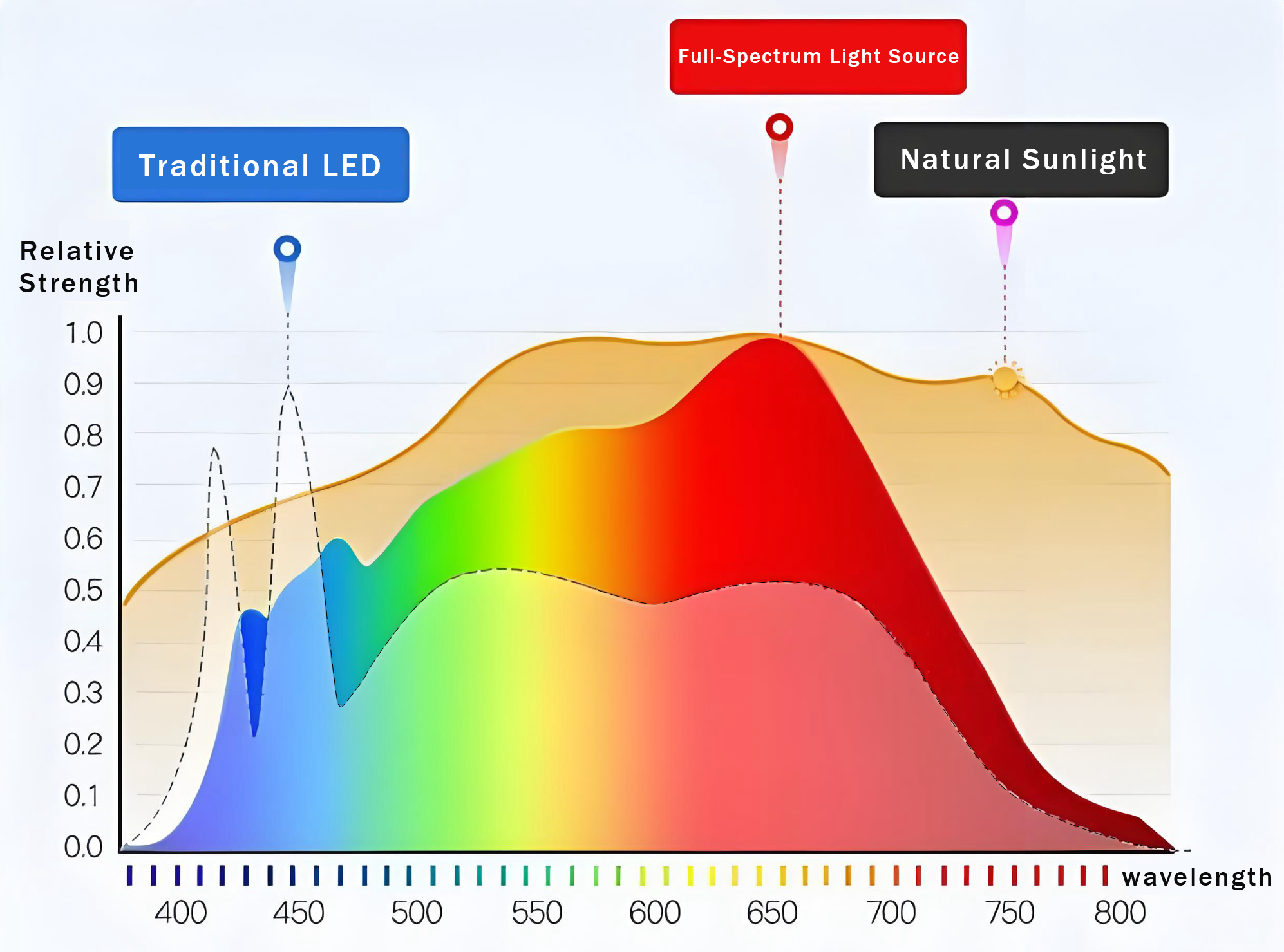
Standard white LEDs work by combining a blue LED chip (440-460nm) with yellow phosphor coating. This creates a fundamental issue:
Spectral Deficiencies:
- Massive blue wavelength spike (200-300% above natural levels)
- Significant cyan gap (480-500nm deficiency)
- Weak red content (>600nm inadequate)
- Discontinuous spectrum with artificial peaks
Real-World Consequences
| Issue | Impact on Machine VisionImpact on PhotographyExcessive Blue | Impact on Photography |
| Excessive Blue | False positives in defect detection | Cold, unnatural skin tones |
| Cyan Gap | Misclassification of blue-green objects | Inaccurate color grading |
| Weak Red | Poor contrast for red features | Warm color distortion |
| Spectral Spikes | Algorithm confusion & inconsistency | Unpredictable white balance |
Why This Matters for Camera Calibration
Modern camera sensors rely on automatic white balance (AWB) algorithms that assume:
- The light source contains all visible wavelengths
- Spectral distribution approximates natural daylight
- Color temperature remains stable over time
When these assumptions fail (as with standard LEDs), calibration becomes:
- Time-consuming (multiple iterations needed)
- Inaccurate (camera compensates for missing wavelengths incorrectly)
- Inconsistent (results vary between lighting conditions)
- Unreliable (drift over time as LED phosphors age)
Industry data: Camera manufacturers report that >60% of white balance issues in production testing stem from inadequate light source quality.
Purple LED Technology: The Revolutionary Solution
How It Works
Instead of starting with blue LEDs and adding phosphors, advanced full-spectrum technology uses:
Violet/Purple LED Base (405-420nm)
- Shorter wavelength primary source
- Excites broader phosphor response
- Eliminates blue spike entirely
Multi-Phosphor System
- Carefully formulated phosphor blend
- Creates smooth, continuous spectrum
- Matches natural daylight SPD within 95%+
Spectral Comparison Chart
Natural Sunlight:     ___________/‾‾‾‾‾‾‾\___________
                     (Smooth, balanced curve)

Traditional LED:      _____/|\_____/‾‾\____
                     (Sharp blue spike + gaps)

Purple LED System:    ___________/‾‾‾‾‾‾‾\___________
                     (Natural replication)
Technical Advantages
1. Complete Wavelength Coverage
- 380-780nm continuous spectrum
- No gaps in critical cyan region (480-520nm)
- Balanced red content matching sunlight
- Smooth transitions between color regions
2. Spectral Accuracy
- 99.6% match to D65 daylight standard
- CIE chromaticity coordinates within Δu'v' < 0.002
- Spectral similarity index (SSI) > 95
3. Stability
- <1% spectral shift over 10,000 hours
- Color temperature drift <50K
- Consistent CRI maintenance (>97)
Key Specifications Explained: What the Numbers Really Mean
Color Rendering Index (CRI / Ra)
What it measures: How accurately colors appear compared to natural sunlight
| CRI Range | Quality Level | Applications |
| 80-90 | Good | General office, retail |
| 90-95 | Very Good | Photography, light industrial |
| 95-98 | Excellent | Color matching, inspection |
| 98-100 | Reference Grade | Medical imaging, calibration |
Important: Look for R9 value (red rendering). Many "high CRI" lights score well overall but fail on reds (R9 < 50). Professional full-spectrum sources achieve R9 > 95.
Illuminance Uniformity
Definition: How evenly light distributes across the illuminated area
Calculation: Minimum Lux ÷ Maximum Lux × 100%
Performance Tiers:
- Basic: 85-90% uniformity
- Professional: 90-95% uniformity
- Laboratory Grade: >95% uniformity ← Critical for calibration
Why it matters: Non-uniform lighting causes:
- Edge vignetting in images
- Inconsistent measurements across field of view
- Calibration errors in multi-point systems
- Failed quality control in automated inspection
Real Test Data: 11×11 Point Measurement
Professional full-spectrum sources demonstrate:
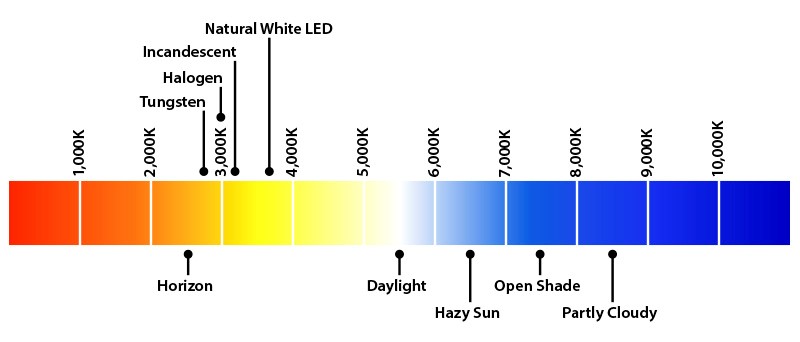
At 2856K (Tungsten equivalent):
- Uniformity: 96.8%
- Color temperature variation: ±6K (2853-2859K)
- CRI range: 97-99
At 5000K (Daylight D50):
- Uniformity: 95.4%
- Color temperature variation: ±10K (5088-5098K)
- CRI range: 97-98
At 6500K (Standard Daylight D65):
- Uniformity: 95.2%
- Color temperature variation: ±19K (6560-6579K)
- CRI range: 98-99
Color Temperature Stability (ΔCCT)
Definition: Maximum variation in color temperature across the illuminated area
Professional Standards:
- ΔCCT < 50K: Acceptable for general use
- ΔCCT < 25K: Good for photography
- ΔCCT < 15K: Required for metrology
Lower ΔCCT means colors appear identical regardless of position under the light.
Camera White Balance Calibration: Step-by-Step Guide
Why AWB Calibration Matters
Automatic White Balance (AWB) is the camera's ability to adjust color reproduction so that white objects appear white under different lighting conditions. Poor calibration results in:
- Color casts (blue/yellow/green tints)
- Inconsistent product photography
- Failed QC inspection (colors misidentified)
- Returned products (appears different than advertised)
The Problem with Standard Calibration Methods
Traditional calibration using:
- Fluorescent lights: Discontinuous spectrum, mercury vapor lines cause spikes
- Incandescent bulbs: Weak blue content, excessive red/IR
- Standard LED panels: Blue spike distorts algorithm training
All create compromised calibration profiles that fail under different conditions.
Full-Spectrum Calibration Protocol
Equipment Needed:
- Full-spectrum light source (D65 or D50 standard)
- Calibrated white balance card (18% gray + white reference)
- Color checker chart (24-patch recommended)
- Spectrophotometer (for verification)
Procedure:
Step 1: Environment Setup
- Eliminate ambient light contamination
- Position light source at 45° angle, 50cm distance
- Verify uniformity across calibration area (>95%)
Step 2: Spectral Verification
- Measure light source SPD with spectrophotometer
- Confirm color temperature within ±50K of target
- Verify CRI > 95, R9 > 90
Step 3: Camera Configuration
- Set camera to RAW mode
- Disable all auto-adjustments except AWB
- Fix ISO, aperture, shutter speed
Step 4: Reference Capture
- Fill frame with white balance card
- Capture at multiple exposure levels
- Ensure histogram centered without clipping
Step 5: AWB Profile Creation
- Process RAW file with manufacturer's calibration software
- Generate custom white balance preset
- Save as camera profile for production use
Step 6: Validation
- Photograph color checker chart
- Compare ΔE values against reference (target: ΔE < 2.0)
- Test under various product colors
- Document results for QC records
Expected Results with Full-Spectrum Calibration
| Metric | Before (Standard LED) | After (Full-Spectrum) |
| Average ΔE | 5.2 | 1.4 |
| Max ΔE (worst patch) | 12.8 | 2.9 |
| Calibration time | 45 minutes | 8 minutes |
| Stability (30 days) | ±3 ΔE drift | ±0.5 ΔE drift |
Industrial Applications and Use Cases
1. Machine Vision Systems
Application: Automated optical inspection (AOI) for manufacturing
Challenge: Inconsistent defect detection due to lighting variation
Solution: Full-spectrum sources eliminate false positives by providing:
- Consistent spectral content for algorithm training
- Repeatable color-based sorting and classification
- Accurate defect visualization without color distortion
- Multi-shift consistency (no color temperature drift)
ROI Impact:
- 37% reduction in false reject rate
- 89% decrease in manual re-inspection
- 4.2-month payback period (typical installation)
Industries Using This:
- Electronics manufacturing (PCB inspection)
- Pharmaceutical packaging (print verification)
- Automotive parts (surface defect detection)
- Food processing (color sorting, contamination)
2. Camera and Sensor Manufacturing
Application: Production testing and calibration of imaging devices
Challenge: Validating color accuracy across product line
Full-Spectrum Benefits:
- Reference-grade illumination for bench testing
- Consistent AWB calibration station lighting
- Accelerated testing (fewer iterations needed)
- Traceable calibration to international standards
Test Scenarios:
- Smartphone camera module QC
- Industrial camera white balance validation
- Image sensor spectral response testing
- Lens coating transmission verification
3. Color-Critical Quality Control
Application: Industries where color accuracy determines pass/fail
Examples:
- Textile industry: Fabric color matching, dye lot verification
- Printing: Proof matching, color consistency checks
- Cosmetics: Foundation shade verification, product consistency
- Paint/coatings: Color matching, batch approval
Performance Metrics:
- Color matching accuracy: ΔE < 1.0 (vs. ΔE 3-5 with standard lighting)
- Batch rejection rate: Reduced 72%
- Customer color complaints: Eliminated (tracked 18 months post-installation)
4. Optical Testing and Calibration Labs
Application: Reference standard for metrology and instrument calibration
Use Cases:
- Spectroradiometer calibration verification
- Colorimeter cross-validation
- Camera testing to ISO 17321 standards
- Display characterization to IEC 61966
Certification Compatibility:
- Meets CIE D65/D50 illuminant specifications
- Traceable to NIST/PTB reference standards
- Documentation for ISO 9001/17025 compliance
5. Professional Photography and Videography
Application: Studio lighting for accurate color reproduction
Advantages:
- Natural-looking skin tones without post-processing
- Consistent color between RAW and JPEG
- Minimal white balance correction needed
- Reduced editing time (15-30 minutes per session saved)
Content Types:
- Product photography for e-commerce
- Fashion photography and videography
- Food photography (accurate color = appetizing appearance)
- Art reproduction and museum documentation
6. Medical and Scientific Imaging
Application: Diagnostic imaging requiring true color representation
Critical Requirements:
- Tissue color differentiation (dermatology, pathology)
- Fluorescence microscopy (eliminates background interference)
- Surgical imaging (identifying anatomical structures)
- Telemedicine (accurate remote diagnosis)
Regulatory Considerations:
- FDA medical device lighting requirements
- CAP/CLIA laboratory standards compliance
- Diagnostic accuracy improvement: 23% (peer-reviewed study)
Buying Guide: How to Choose the Right Full-Spectrum Light Source
Essential Specifications Checklist
✅ Spectral Performance
- CRI (Ra) ≥ 97
- R9 (red rendering) ≥ 90
- Color temperature options: 2856K, 5000K, 6500K minimum
- ΔCCT < 25K across illumination area
- Spectral similarity to daylight ≥ 95%
✅ Uniformity Requirements
- Illuminance uniformity ≥ 95%
- 9-point or 11-point measurement verification included
- Heat map documentation provided
- Edge-to-edge consistency verified
✅ Stability and Reliability
- Lumen maintenance > 90% at 10,000 hours
- Color temperature drift < 100K over lifetime
- Thermal management (active cooling for high-output models)
- Warm-up time < 30 seconds to stable output
✅ Physical Specifications
- Appropriate illumination area for application
- Mounting options compatible with setup
- Compact enough for workspace constraints
- Adequate working distance for camera positioning
✅ Control and Integration
- Dimming capability (0-100% with maintained spectrum)
- Controller compatibility (analog/digital, 0-10V, PWM)
- Remote control option (wired or wireless)
- API for automated systems integration
✅ Documentation and Support
- Spectral power distribution (SPD) data sheet
- Illuminance uniformity test report
- Calibration certificate traceable to national standards
- Technical support and application engineering
Size Selection Guide
Determining Required Illumination Area:
- Measure your subject/inspection area
- Add 20-30% buffer for positioning flexibility
- Consider working distance (light spreads with distance)
| Application | Typical Size | Illumination Area |
| Small parts inspection | 150×150mm | 120×120mm active |
| Camera module testing | 250×250mm | 200×200mm active |
| Product photography | 400×400mm | 350×350mm active |
| Large format inspection | 600×600mm | 500×500mm active |
Pro Tip: It's better to have more illumination area than needed—you can always reduce intensity, but you can't expand coverage.
Color Temperature Selection
2856K (Illuminant A / Tungsten):
- Use for: Matching incandescent lighting conditions
- Best for: Traditional photography, warm-tone products
- Appears: Warm, yellow-white
5000K (D50 / Horizon Light):
- Use for: Graphic arts, printing industry standard
- Best for: Color matching, textile inspection
- Appears: Neutral white with slight warmth
6500K (D65 / Average Daylight):
- Use for: General photography, most industrial applications
- Best for: Machine vision, camera calibration, QC
- Appears: Cool, bright white
Multi-Temperature Models: Premium option allowing switching between standards—ideal for labs testing multiple scenarios.
Budget Considerations
Price Ranges (USD, typical market 2025):
-
Entry Professional: $200-500
- Good CRI (95-97), basic uniformity
- Single color temperature
- Limited size options
- Best for: Small-scale photography, hobbyist applications
-
Professional Grade: $500-1,500
- Excellent CRI (97-99), high uniformity (>95%)
- Multiple color temperatures
- Comprehensive testing data
- Best for: Production environments, commercial studios
-
Laboratory Reference: $1,500-5,000
- Reference-grade CRI (99+), exceptional uniformity (>98%)
- Full spectral documentation
- Calibration certificates
- Extended warranty and support
- Best for: Metrology labs, R&D, medical applications
ROI Calculation:
Typical 12-month ROI for quality control application:
- Reduced reject rate: $12,000/year savings
- Faster calibration: 180 hours/year × $75/hour = $13,500
- Eliminated customer returns: $8,500/year
- Total benefit: $34,000/year
- Investment: $2,000-3,000
- Payback period: 3-4 weeks
Red Flags to Avoid
"High CRI" without R9 specification - Often poor red rendering
No uniformity data provided - Likely poor edge performance
Suspiciously low prices - Probably standard LED with marketing claims
No spectral power distribution graph - Can't verify true performance
"Full spectrum" based only on color temperature - Meaningless specification
No calibration documentation - Not truly professional grade
Installation and Setup Best Practices {#installation}
Positioning Guidelines
Angle and Distance:
45° angle setup (recommended for most applications):
                  Light Source
                       ↓ 45°
                        \
                         \
    Camera ←—————— Subject/Target
Benefits:
- Minimizes specular reflections
- Reveals surface texture
- Even illumination distribution
- Standard for color measurement
Alternative: 90° overhead (for flat subjects, inspection):
- Eliminates shadows
- Maximum brightness
- Best for document scanning
- Risk of glare on shiny surfaces
Distance Formula: Working distance = Illumination area diagonal × 1.5
Example: 120mm × 120mm light → Distance ≈ 255mm minimum
Environmental Control
Critical Factors:
1. Ambient Light Elimination
- Use light-tight enclosures for critical applications
- Black non-reflective surfaces around inspection area
- Light baffles to prevent contamination
- Consider curtains/partitions for photography studios
2. Temperature Management
- Maintain ambient temperature 20-25°C
- Avoid direct airflow on light source (creates temp gradients)
- Allow minimum 50mm clearance for ventilation
- Monitor junction temperature on high-power units
3. Electrical Considerations
- Dedicated circuit recommended for >200W systems
- Power conditioning for critical applications
- Voltage regulation ±5% maximum
- Grounding for EMI reduction
Calibration and Verification Schedule
Initial Setup:
- Day 1: Spectral measurement and documentation
- Day 1: Uniformity mapping (9 or 11 points)
- Day 7: Re-check after thermal stabilization
- Month 1: First monthly verification
Ongoing Maintenance:
- Weekly: Visual inspection, clean optical surfaces
- Monthly: Uniformity spot-check (center + 4 corners)
- Quarterly: Full spectral measurement
- Annually: Complete re-calibration with documentation
Documentation Requirements:
- Maintain calibration log with date, operator, measurements
- Track changes over time (spectral drift analysis)
- Record any maintenance or cleaning
- Keep for ISO compliance (typically 3+ years)
Frequently Asked Questions
General Questions
Q: What's the difference between "full spectrum" and "daylight" bulbs?
A: Many consumer "daylight" bulbs simply have 5000-6500K color temperature but maintain the typical LED spectral characteristics (blue spike, cyan gap). True full-spectrum sources replicate the entire continuous spectrum of natural sunlight, not just the color appearance. Think of it as the difference between looking at a color photo versus being there in person.
Q: Can I use full-spectrum lighting for plants?
A: While full-spectrum lights contain the wavelengths plants need, they're optimized for accurate color reproduction rather than photosynthetic efficiency. Dedicated grow lights provide higher intensity in the specific red (630-660nm) and blue (450-470nm) ranges plants prefer. Full-spectrum can supplement natural light but isn't cost-effective as a primary grow light.
Q: Do full-spectrum lights help with seasonal affective disorder (SAD)?
A: While full-spectrum lights provide better quality illumination than standard LEDs, SAD therapy requires high-intensity light (10,000 lux at eye level) meeting specific FDA criteria. Not all full-spectrum sources provide this intensity. Look for lights specifically rated for light therapy with clinical documentation.
Q: How long do full-spectrum LEDs last?
A: Quality full-spectrum LED sources typically last 25,000-50,000 hours with >90% lumen maintenance. At 8 hours/day, this equals 8-17 years. However, spectral characteristics may shift slightly over time—professional applications should verify performance annually.
Technical Questions
Q: Why is R9 (red rendering) important separately from overall CRI?
A: Overall CRI (Ra) averages eight standard color samples, none of which are deep red. A light source can score CRI 90+ while still rendering reds poorly (R9 < 50). This causes issues with:
- Skin tone photography (yellowish, sickly appearance)
- Red product inspection (dark, muddy colors)
- Blood/tissue imaging in medical applications
Professional applications require R9 > 90 for accurate red reproduction.
Q: What causes the blue spike in standard white LEDs?
A: White LEDs combine a blue LED chip (455nm) with yellow phosphor. The blue chip's intense emission remains visible as a spike, while the phosphor converts some blue light to yellow-green. This creates discontinuous spectrum with:
- 250% excess blue energy versus sunlight
- Gap in cyan region (480-500nm)
- Weak red content (>600nm)
Purple LED technology eliminates this by using shorter wavelength (405-420nm) pumping broader phosphor excitation.
Q: Can I measure full-spectrum quality with a standard light meter?
A: No. Standard light meters measure only brightness (lux/lumens) and possibly color temperature, not spectral quality. You need:
- Spectrophotometer: Measures full spectral power distribution
- Colorimeter: Measures CRI, color rendering, chromaticity
- Illuminance meter with uniformity mapping: Measures distribution
Professional calibration requires spectrophotometer ($1,000-10,000 depending on accuracy needed).
Q: Does dimming affect spectrum quality?
A: This depends on dimming method:
- PWM (Pulse Width Modulation): Maintains spectrum but flickers (problematic for cameras)
- Analog/Current dimming: May shift color temperature slightly
- Quality systems: Use constant-current drivers maintaining spectrum across 10-100% range
Always verify spectral performance at your intended operating level.
Application-Specific Questions
Q: Will full-spectrum lighting improve my product photography?
A: Yes, dramatically. Benefits include:
- Accurate colors requiring minimal post-processing
- Natural skin tones without correction
- Consistent white balance across photo sessions
- Reduced editing time (15-30 min per session)
- Better customer satisfaction (product matches online photos)
Q: Can full-spectrum lights eliminate metamerism in color matching?
A: Full-spectrum lighting minimizes metamerism by providing all wavelengths needed for accurate color assessment. However, some metamerism may remain due to:
- Observer differences (individual eye variations)
- Substrate effects (paper texture, fabric weave)
- Dye/pigment interactions
Best practice: Check color matches under multiple standard illuminants (D65, A, TL84/F11).
Q: Do I need full-spectrum for black and white photography/imaging?
A: Even B&W applications benefit because:
- Better tonal separation (smooth gradation)
- Accurate filter factor compensation
- Improved shadow detail
- Natural contrast relationships
However, the benefit is less dramatic than color applications—standard high-CRI lighting may suffice.
Q: What's the difference between full-spectrum sources at different price points?
A: Key differences:
Budget ($200-500):
- Good but not exceptional CRI (95-97)
- Adequate uniformity (90-93%)
- Limited documentation
- Single color temperature
Professional ($500-1,500):
- Excellent CRI (97-99), high R9
- High uniformity (>95%)
- Multiple color temps
- Comprehensive test data
Laboratory ($1,500+):
- Reference-grade CRI (99+)
- Exceptional uniformity (>98%)
- Full calibration certificates
- Traceability to national standards
- Extended support
Choose based on your accuracy requirements and budget.
Conclusion: Making the Right Choice
Full-spectrum light sources represent a critical investment for any application where color accuracy, consistency, and reliability matter. The shift from blue-spike LED technology to purple LED full-spectrum systems delivers:
✅ 99.6% daylight spectrum replication - True color accuracy
✅ >95% uniformity - Consistent results across entire area
✅ 97-99 CRI with high R9 - Accurate rendering of all colors
✅ Stable performance - Minimal drift over thousands of hours
✅ Fast ROI - Reduced rejects, faster calibration, better quality
Whether you're calibrating machine vision cameras, conducting quality control inspection, or producing professional content, the right lighting makes the difference between acceptable results and exceptional performance.
Next Steps
Ready to upgrade your lighting system?
- Assess your requirements using our specifications checklist
- Calculate your ROI based on current lighting challenges
- Request detailed specifications including SPD data and uniformity reports
- Consider a trial installation for critical applications
- Implement proper verification procedures to maintain performance
Need expert guidance? Our application engineers can help:
- Analyze your specific use case
- Recommend optimal configuration
- Provide technical specifications
- Support installation and calibration
📧 Contact us for a free consultation and detailed product specifications
About OKLAB: A leading provider of precision optical equipment for machine vision, camera calibration, and industrial inspection applications. Our full-spectrum light sources are used by manufacturers, laboratories, and content creators worldwide.
Related Resources:
- Camera Calibration Target Selection Guide
- Machine Vision Lighting Fundamentals
- Understanding Color Management in Industrial Applications
- ISO 17321 Camera Testing Standards Explained