
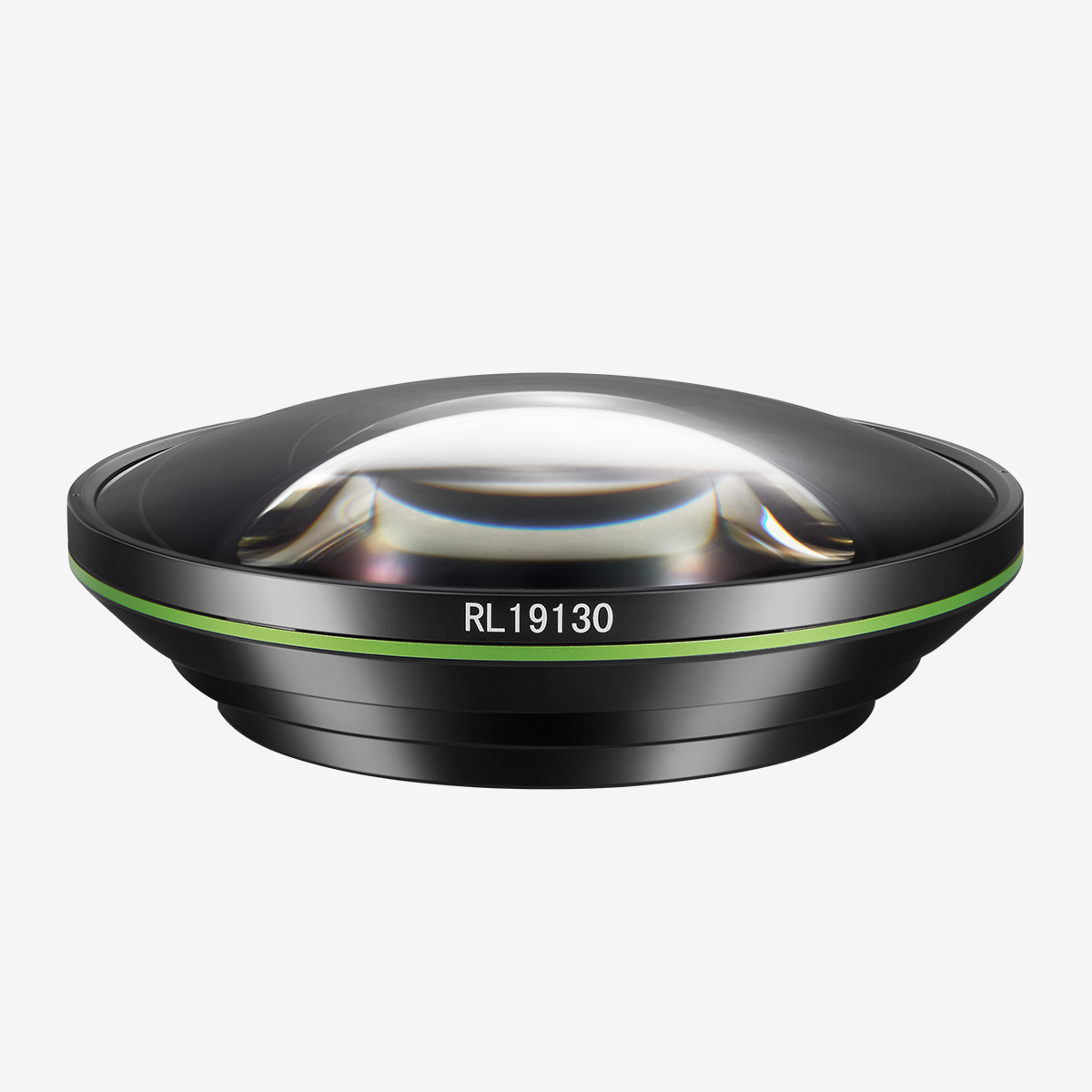


Wide-Angle Relay Lens Specification
| Model | RL19130 |
| FOV Angle | 130° |
| MDR | 19mm |
| Aperture | 4mm |
| Weight | 1.48kg |
| Range of Simulated Distance | 400-INFmm |
| Distortion | <30% |
| Outline Dimensions | Φ145x48.94mm |
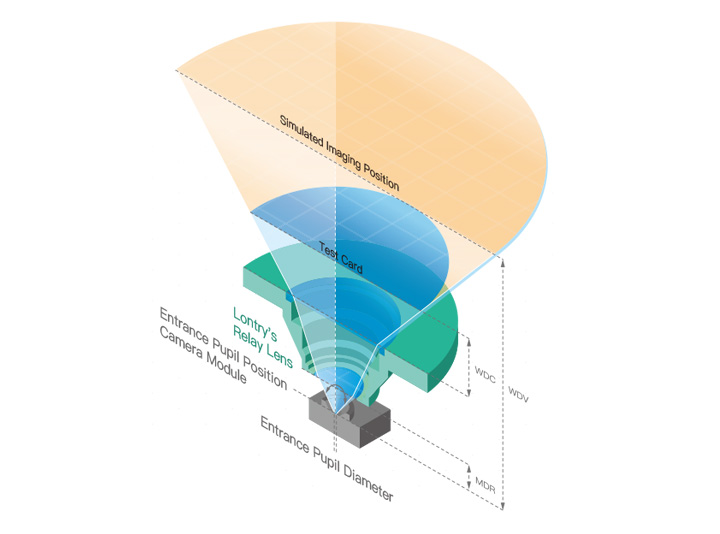
Structural Dimension Drawing of Wide-Angle Relay Lens

*MDR: The installation distance from the camera module to the relay lens camera end . WDV: Distance from the camera module to the simulated imaging position.
WDC: Distance from the relay lens object end to the test card.
Optical Properties of Wide-Angle Relay Lens


Size of Test Card at Maximum Angle
| WDV (mm)Distance from the Camera Module to the Simulated Imaging Position | WDC (mm)Distance from the Relay Lens Object End to the Test Card | Test Card Dimensions(LXW) | |||
| 16:9 | 4:3 | ||||
| Length (mm) | Width (mm) | Length (mm) | Width (mm) | ||
| 400 | 206.21 | 579.06 | 325.72 | 531.50 | 398.63 |
| 1000 | 315.10 | 822.27 | 462.53 | 754.75 | 566.06 |
| 5000 | 424.10 | 1065.73 | 599.47 | 978.21 | 733.66 |
| Infinite Distance | 455.75 | 1136.41 | 639.23 | 1043.09 | 782.32 |
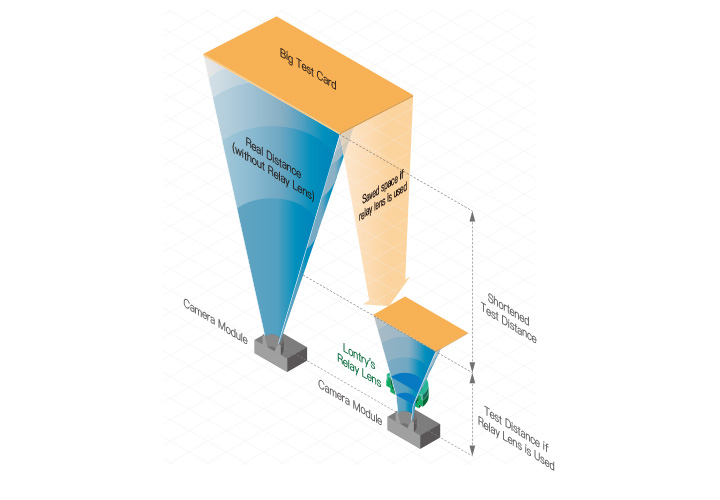
Why use Wide-Angle Relay Lens?
• Reducing Testing Cost
When the camera module is tested, you need a large test distance and a large target. If the relay lens is used, you can shorten the test distance and reduce the test chart, thereby reducing the test cost in the end.
• Improving Test Credibility
Using relay lens in testing can ensure high-quality imaging and footage. What's more, due to the standard test environment, the impact of random errors and uncontrollable factors on the test results can be significantly reduced and the test credibility can be improved.
• Increasing Production Efficiency
As relay lens is widely used in the testing of camera modules, the size of production and testing equipment related to camera modules has been well controlled, improving productivity and reducing costs. It also provides effective and feasible solutions for other applications that require testing of camera, such as laboratories.
Application of Wide-Angle Relay Lens
Relay lens is mainly used for camera resolution test. With the development of mobile camera, its application has been constantly extended. It has been used in vehicle, security, video conference equipment, smart home and other fields. In particular, it plays an irreplaceable role in the production and testing of wide-angle and long-focus modules.
Currently, simulation testing (relay lens or collimator array) is almost the only solution in all mass AA (active alignment) production processes, module focusing, and product terminal testing.
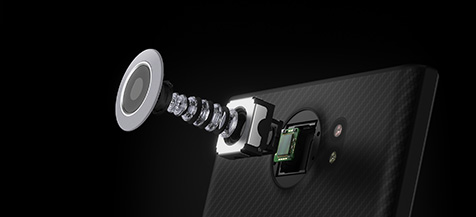
Mobile Camera
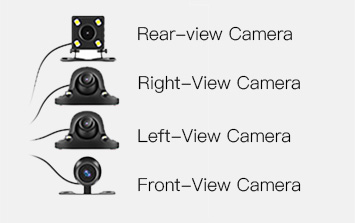
On-Board Camera
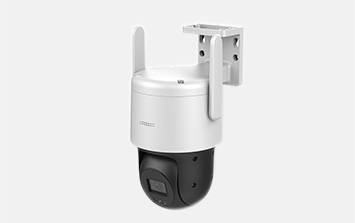
Security Camera
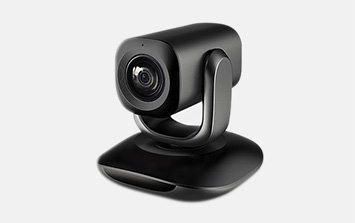
Video Conference Camera
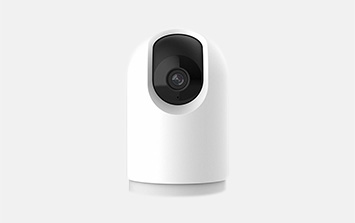
Smart Home Camera
How to select Wide-Angle Relay Lens?
1: FOV
The design FOV of a relay lens shall be slightly larger than the FOV of the camera module.
2: Installation
The parameter design of relay lens takes into account the support for installation structure, so the following three data should be considered when selecting a relay lens:
MDR (the distance from the mechanical rear surface of relay lens to the camera viewpoint) of 6-40mm is suitable;
WDC (the distance from the mechanical front surface (non-optical surface) of relay lens to the chart being tested) shall be usually 150-400mm;
The maximum chart size that the test environment can support.
3: Entrance pupil diameter
The entrance pupil diameter (EFL focal length/F.no focal number) of a product shall be smaller than the exit pupil diameter of relay lens.
Elements included in a typical Wide-Angle Relay Lens Test Environment
The luminous area shall be customized according to the parameters of a relay lens; Uniformity shall be greater than 90%; Color temperature shall be 2,700-7,000k; Various infrared bands are optional.
Film is most commonly used; Accuracy shall be ±10 μm; Accuracy shall not be less than 8,000DPI; Suitable edge sharpness of graphics.
Select a relay lens according to its optical parameters and test environment.
The center of the tested product, relay lens and chart shall be on the same optical axis; Fixed or adjustable height.
Camera Module
FAQ of Wide-Angle Relay Lens
1. Does a 130° Wide-angle relay lens automatically provide full coverage for a camera module also rated at 130°?
Not necessarily. A relay lens should have a design field of view slightly larger than the camera module’s verified maximum field of view to provide sufficient alignment margin. Although RL19130 functions as an Ultra Wide Angle Relay Lens with a maximum FOV of 130°, a camera module also rated at 130° should be evaluated using the same horizontal, vertical, or diagonal FOV definition before compatibility is confirmed.
2. Why does the Wide-angle relay lens require different test-chart dimensions for 16:9 and 4:3 camera modules?
The two aspect ratios produce different rectangular coverage areas at the same field angle. When this Camera Module Relay Lens simulates a 400 mm viewing distance with a WDC of 206.21 mm, the required chart dimensions are 579.06 × 325.72 mm for 16:9 and 531.50 × 398.63 mm for 4:3. The chart should therefore be selected according to the camera module’s actual sensor aspect ratio.
3. How should the distortion specification of the Wide-angle relay lens be handled during image-quality analysis?
RL19130 has a specified distortion value of approximately 29%, stated as less than 30% in the product specifications. When it is used as a Camera Testing Relay Lens, this distortion becomes part of the test bench’s geometric response. A reference mapping or baseline calibration should be established so that relay-lens distortion is not incorrectly attributed to the camera module under test.
4. What mounting support is required for the Wide-angle relay lens?
RL19130 measures approximately Φ145 × 48.94 mm and weighs 1.48 kg. This Optical Relay Lens should be installed in a rigid fixture capable of supporting its weight without loading the camera module or fine-adjustment mechanism. The fixture should also maintain stable coaxial alignment among the camera, relay lens, and test chart.
5. At which production stages can the Wide-angle relay lens be integrated?
RL19130 can be integrated into simulated-distance testing stations for mass-production active alignment, camera-module focusing, resolution evaluation, and final product verification. If one station is used for multiple processes, the chart position, illumination, alignment, and evaluation criteria should be validated separately for each production stage.
6. How much target-stage travel is required when the Wide-angle relay lens switches from a 400 mm simulated distance to infinity?
If the relay lens remains fixed, the chart-to-lens distance changes from a WDC of 206.21 mm at a 400 mm simulated distance to 455.75 mm at infinity. The required travel is therefore 249.54 mm. In practice, the stage should provide additional travel for homing, chart thickness, installation clearance, and alignment adjustment.
