
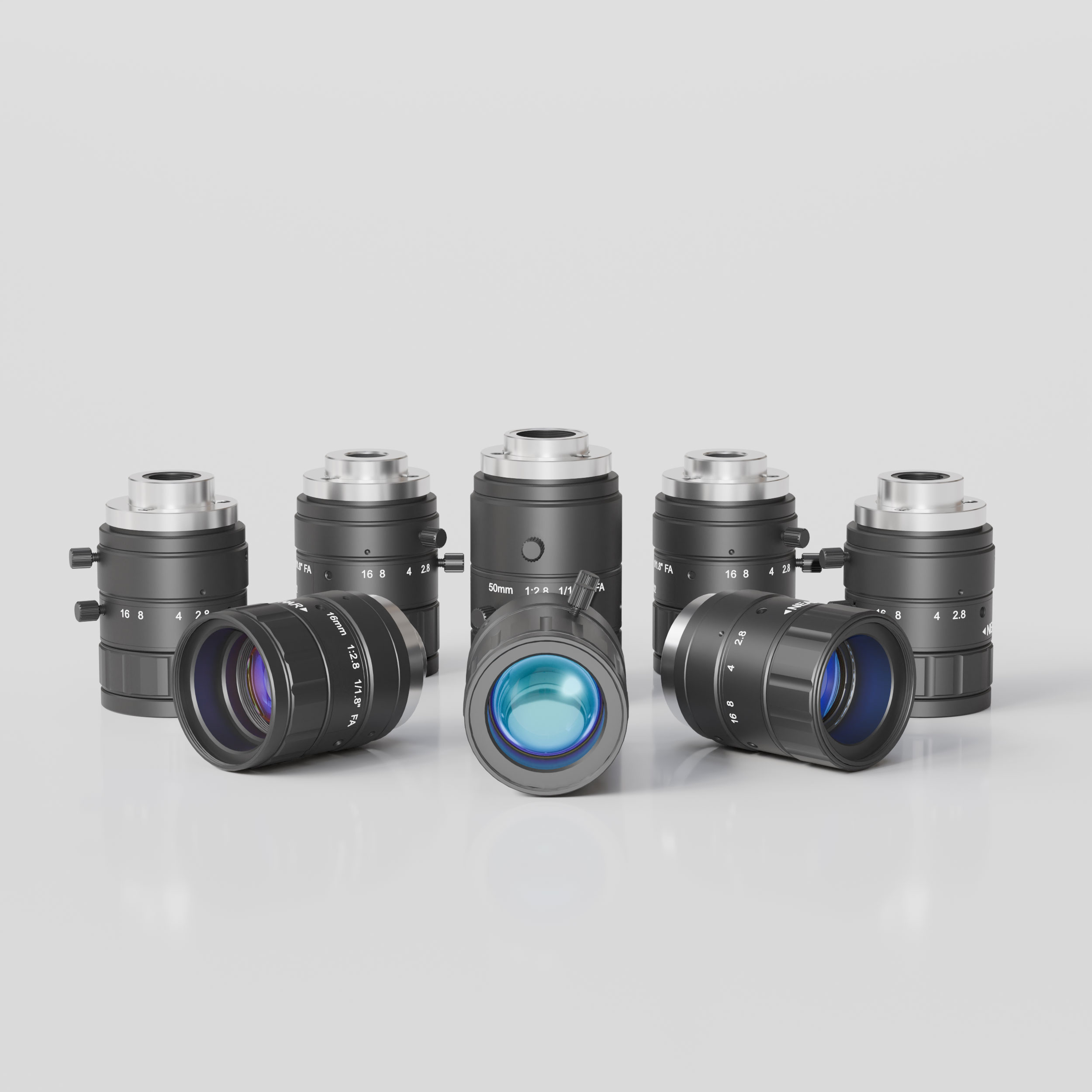
Choosing between an 8mm, 12mm, 16mm, 25mm, 35mm, or 50mm lens depends primarily on the required Field of View, Working Distance, and Camera Sensor Size.
With the same Sensor Size and Working Distance, a shorter focal length generally provides a wider field of view, while a longer focal length makes the target occupy a larger portion of the image.
1. Comparing the Field of View of 8mm, 12mm, 16mm, 25mm, 35mm, and 50mm Lenses
With the same Sensor Size and Working Distance, these six focal lengths provide different fields of view. For conventional non-macro imaging, Horizontal Field of View is approximately inversely proportional to Focal Length.
Using the horizontal field of view of an 8mm lens as a 100% reference, the following sections compare the relative field of view of the other five focal lengths.
① 8mm Focal Length
- Relative Horizontal FOV: 100%, making it the widest field of view among the six focal lengths.
- Imaging Difference: Compared with a 16mm lens, an 8mm lens provides approximately twice the horizontal coverage, allowing a larger physical area to be captured in the same image.
② 12mm Focal Length
- Relative Horizontal FOV: Approximately 67% of an 8mm lens, placing its field of view between 8mm and 16mm.
- Imaging Difference: Compared with 8mm, the horizontal field of view is reduced by approximately one-third, while the width occupied by the same target in the image increases by approximately 50%.
③ 16mm Focal Length
- Relative Horizontal FOV: Approximately 50% of an 8mm lens.
- Imaging Difference: Compared with 12mm, the horizontal field of view is reduced by approximately 25%, while the width occupied by the same target in the image increases by approximately 33%.
④ 25mm Focal Length
- Relative Horizontal FOV: Approximately 32% of an 8mm lens.
- Imaging Difference: Compared with 16mm, the horizontal field of view is reduced by approximately 36%, allowing a smaller target area to occupy more of the image.
⑤ 35mm Focal Length
- Relative Horizontal FOV: Approximately 23% of an 8mm lens.
- Imaging Difference: Compared with 25mm, the horizontal field of view is reduced by approximately 29%, making the same target occupy a larger proportion of the image.
⑥ 50mm Focal Length
- Relative Horizontal FOV: Approximately 16% of an 8mm lens, making it the narrowest field of view among the six focal lengths.
- Imaging Difference: Under the same imaging conditions, the width occupied by the same target in the image is approximately 6.25 times that with an 8mm lens.
2. How to Choose the Right Focal Length: 8mm, 12mm, 16mm, 25mm, 35mm, or 50mm
To choose the right focal length, calculate the required Focal Length first, then verify the actual lens specifications.
① Calculate the Required Focal Length
Estimate the required focal length based on the effective size of the Camera Sensor, the actual Working Distance, and the Required Field of View.
- Sensor Width: Use the actual effective imaging width of the camera Sensor.
- Working Distance: Use the actual installation distance during normal equipment operation and confirm how the lens manufacturer defines Working Distance.
- Horizontal FOV: Use the horizontal width that needs to be covered by the inspection area, including the necessary edge margin.
Under conventional non-macro imaging conditions, the following approximate formula can be used:
Focal Length ≈ (Sensor Width × Working Distance) ÷ Horizontal FOV
② Select 8mm, 12mm, 16mm, 25mm, 35mm, or 50mm Based on the Calculation
When Sensor Size and Working Distance are fixed, use the calculated focal length to identify the longest lens that still provides sufficient FOV.
Based on the approximate formula above, the following ranges can be used for initial selection:
- 8mm Lens: When the calculated required focal length is from 8mm to less than 12mm.
- 12mm Lens: When the calculated required focal length is from 12mm to less than 16mm.
- 16mm Lens: When the calculated required focal length is from 16mm to less than 25mm.
- 25mm Lens: When the calculated required focal length is from 25mm to less than 35mm.
- 35mm Lens: When the calculated required focal length is from 35mm to less than 50mm.
- 50mm Lens: When the calculated required focal length is 50mm or greater and the selection is limited to these six focal lengths.
If the calculated focal length is less than 8mm, choose a shorter focal length or increase the Working Distance to obtain the required FOV.
③ Confirm the Final Focal Length Based on the Actual Field of View
After the initial selection, verify the imaging specifications of the candidate lens under the actual working conditions.
For examples of fixed focal length lens options, you can review the FP117 Series Fixed Focal Length Lenses and FT230 Series Fixed Focal Length Lenses.
- Horizontal and Vertical FOV: Confirm that the actual horizontal and vertical fields of view fully cover the inspection area and the necessary margin.
- Focus Range: Confirm that the lens can achieve clear focus at the specified Working Distance.
- Final Lens Selection: If the field of view is insufficient, choose a shorter focal length. If the field of view exceeds the requirement, consider a longer focal length while ensuring that the actual FOV still fully covers the inspection area.