
Camera calibration isn't optional anymore. It's the foundation of every machine vision system that needs accurate measurements. Miss this step, and your entire project struggles with distorted images and unreliable data.
Traditional checkerboard patterns work. But they come with real limitations that cost you time and accuracy. That's where ChArUco boards change the game.
What Is a ChArUco Board and Why It Matters
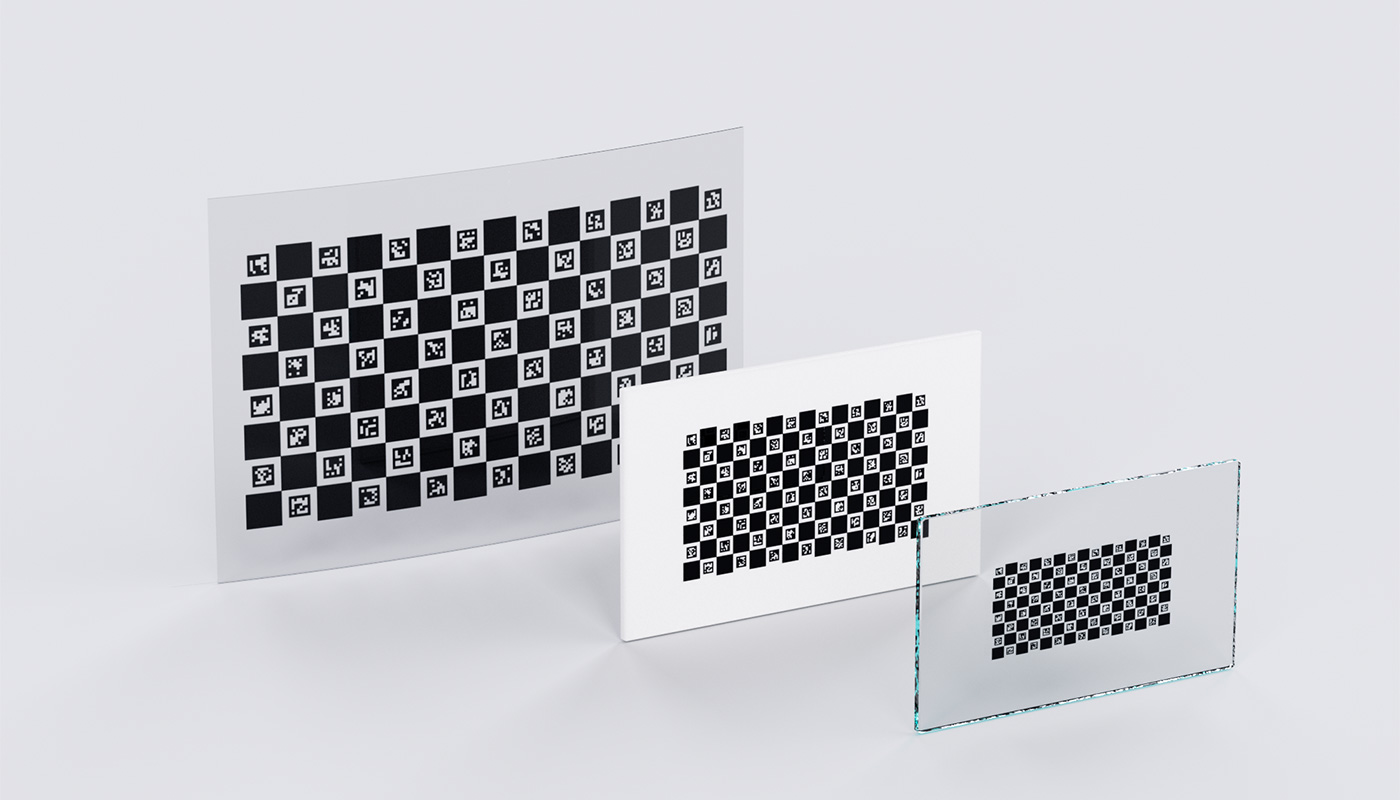
ChArUco combines two proven technologies: checkerboard patterns and ArUco markers.
The checkerboard gives you precise corner detection. Sub-pixel accuracy. The kind of precision metrology applications demand.
The ArUco markers add unique identifiers to each corner. No more guessing which corner is which. No rotation ambiguity. Each corner has its own digital fingerprint.
This hybrid design solves problems that have frustrated vision engineers for years.
How ChArUco Boards Solve the Partial Occlusion Problem
Here's a common scenario:
You're calibrating a wide-angle lens. You need data from the image edges where distortion hits hardest. But with a traditional checkerboard, you have a problem. Move the board to capture those edge regions, and part of it leaves the frame. Detection fails. You lose that critical data.
With ChArUco, partial visibility works perfectly.
See only half the board? No problem. Each visible corner gets identified by its unique ArUco code. The algorithm knows exactly where those corners sit in the pattern. Calibration continues.
This means you can:
- Capture calibration data from extreme image corners
- Work around obstacles in your setup
- Reduce the number of images you need
- Get better distortion parameter estimates
Unique Corner Identification: Key Advantage of ChArUco Calibration
Traditional checkerboards have a fundamental weakness. The pattern repeats. Without seeing the full board, the algorithm can't tell one corner from another.
This creates real issues:
- 180-degree rotation ambiguity with symmetric boards
- Failed detection with partial views
- Inconsistent results across image sets
- Extra images needed to compensate
ChArUco eliminates this completely.
Every corner connects to an ArUco marker with a unique ID. The system always knows which corner it's looking at. Even with just a few corners visible.
For multi-camera calibration, this becomes critical. Multiple cameras see different parts of the board. ChArUco ensures all cameras reference the same exact points. No confusion. No calibration failures.
Achieve Better Camera Calibration Coverage with Fewer Images
Professional calibration requires comprehensive coverage of the image area.
With traditional checkerboards, you need 30-50 images minimum. Maybe more for fisheye lenses. Each image must show the complete board. That limits your angles and positions.
ChArUco cuts this requirement dramatically.
You can position the board at extreme angles. Tilt it heavily. Push it to image edges. Capture data where distortion matters most. All while using fewer total images.
Real-world result: 15-25 well-chosen images often outperform 50 traditional checkerboard images.
The math explains why. You're gathering data from regions traditional methods miss. Edge data. Corner data. The areas where lens models need the most constraint.
ChArUco Board Performance in Challenging Lighting Conditions
Manufacturing floors aren't photography studios. You work with the lighting you have.
Strong overhead LEDs create glare on calibration targets. Ring lights cause semi-specular reflections. Shadows fall across parts of the pattern.
Traditional checkerboard detection? Fails hard.
ChArUco handles imperfect lighting remarkably well. A few markers might wash out or shadow. The remaining markers still get detected. Their corners still provide valid calibration data.
This robustness matters when you're:
- Calibrating cameras in their actual operating environment
- Working with high-power illumination systems
- Testing vision systems on production lines
- Deploying multi-camera arrays in existing facilities
ChArUco Board Technical Specifications and Configuration Guide
Board Configuration:
- Square size: 15mm to 50mm typical (depends on working distance)
- Marker size: 60-75% of square size for optimal detection
- Grid dimensions: 5×7 to 8×11 squares commonly used
- Dictionary options: DICT_4X4_50, DICT_5X5_100, DICT_6X6_250
Detection Requirements:
- Minimum resolution: 8-10 pixels per square edge
- Working distance: 0.5× to 10× board diagonal
- Tilt angles: Up to 60 degrees from perpendicular
- Lighting: 300-1000 lux recommended
Material Options:
- Aluminum boards: Lightweight, durable, matte finish
- Glass substrates: Flat within ±0.05mm, permanent printing
- Ceramic targets: Ultimate flatness, thermal stability
- Paper/film: Cost-effective for occasional use
ChArUco Calibration Board Applications Across Industries
ChArUco Boards for Robotics and Autonomous Systems Calibration
A mobile robot needs to know where it is. Multiple cameras provide that localization. Each camera requires individual calibration. Then stereo calibration between pairs. Finally, extrinsic calibration to the robot frame.
ChArUco makes this workflow practical. Partial views work fine. Each camera sees different board areas. The unique corner IDs keep everything aligned.
Industrial Inspection System Camera Calibration with ChArUco
A 3D inspection system scans automotive body panels. Eight cameras capture different angles. All must share a common coordinate system with sub-millimeter accuracy.
Traditional calibration? Takes hours and still struggles with camera overlap regions. ChArUco? Done in 30 minutes with better accuracy.
AR/VR Headset Camera Calibration Using ChArUco Boards
Head-mounted displays need perfect calibration. Users notice even 0.5-pixel errors. Fish-eye lenses demand comprehensive edge data.
ChArUco provides that edge coverage naturally. Developers capture extreme viewing angles without detection failures. Results: Better distortion correction. More comfortable user experience.
Medical Imaging System Calibration with ChArUco Patterns
Surgical navigation systems track instruments in 3D. Multiple calibrated cameras enable this tracking. Patient safety depends on calibration accuracy.
ChArUco's robust detection reduces calibration uncertainty. The unique identifiers ensure repeatable results. Validation becomes faster and more reliable.
Common Camera Calibration Mistakes to Avoid with ChArUco Boards
Mistake 1: Using Non-Flat ChArUco Calibration Boards
Printing a pattern on paper, then taping it to cardboard. Looks flat. Isn't flat. Air bubbles, warps, and curves introduce systematic errors.
Solution: Use rigid substrates. Aluminum, glass, or precision-printed boards. Verify flatness with a straightedge. Worth the investment.
Mistake 2: Incorrect ChArUco Board Square Size Selection
Too large: Board barely fits in frame. Limited viewing angles. Poor coverage.
Too small: Resolution too low. ArUco markers become unreadable. Detection fails.
Rule of thumb: Board should occupy 30-70% of frame at mid-range distance. Markers need 12+ pixels minimum width.
Mistake 3: Poor Image Diversity in Camera Calibration
Taking 50 images all from similar angles doesn't help. The algorithm sees the same data 50 times.
Better: 20 images with varied positions, rotations, and depths. Include extreme angles. Fill all image regions.
Mistake 4: Ignoring Camera Calibration Reprojection Error
Calibration software returns a reprojection error. This number matters.
Good: < 0.3 pixels
Acceptable: 0.3-1.0 pixels
Problem: > 1.0 pixels
High error indicates board flatness issues, motion blur, or poor corner detection. Don't ignore it. Fix the underlying problem.
How to Choose the Right ChArUco Calibration Board for Your Application
Best ChArUco Board Configuration for Machine Vision Applications
- 7×5 or 8×6 grid
- 25-30mm squares
- DICT_5X5_100 or DICT_6X6_250
- Aluminum substrate
ChArUco Boards for Multi-Camera System Calibration
- Larger boards: 600mm × 800mm
- 40-50mm squares
- Higher density dictionary (more unique IDs)
- Matte finish to reduce inter-camera reflections
ChArUco Calibration Boards for Microscopy and Close-Range Imaging
- 5×4 grid sufficient
- 3-8mm squares
- Glass substrate for flatness
- High-contrast printing
ChArUco Board Setup for Wide-Angle and Fisheye Lens Calibration
- 9×7 or larger grid
- 20-25mm squares
- More corners = better distortion modeling
- Plan for partial views in your image set
Camera Calibration with ChArUco Boards: Step-by-Step Process
Step 1: Generate Your ChArUco Calibration Board Pattern
OpenCV provides board generation tools. Specify your parameters:
squares_x = 8
squares_y = 6
square_length = 30mm
marker_length = 22mm
dictionary = DICT_6X6_250
Print at actual size. Verify dimensions with calipers. Small errors accumulate.
Step 2: Prepare Your Camera Calibration Setup
Mount camera rigidly. No vibration. No movement between captures.
Light the workspace evenly. Avoid direct reflections on the board.
Set camera parameters manually. Fixed exposure. Fixed focus. Auto settings cause inconsistency.
Step 3: Capture ChArUco Board Calibration Images
Aim for 15-25 images minimum. Include:
- Board filling frame (3-4 images)
- Board at various depths (4-5 images)
- Strong tilt angles (4-5 images)
- All four image corners covered (4-5 images)
- Board partially out of frame (3-4 images)
Press shutter gently. Any movement blurs corners. Blurred corners reduce accuracy.
Step 4: Run Camera Calibration Algorithm with ChArUco Data
Modern tools (OpenCV, MATLAB, Halcon) include ChArUco support.
The algorithm:
- Detects ArUco markers in each image
- Interpolates ChArUco corner positions
- Identifies corner IDs uniquely
- Solves for camera intrinsics and distortion
- Returns camera matrix and distortion coefficients
Check the reprojection error. Should be sub-pixel. If not, capture more images or check board flatness.
Step 5: Validate Your Camera Calibration Results
Apply calibration. Undistort test images. Straight lines should appear straight. No waviness at edges.
Measure known dimensions in the scene. Compare to ground truth. Within tolerance? Calibration succeeded.
Save your calibration file. You'll need it for every session.
ChArUco vs Traditional Checkerboard: Performance Comparison
We tested both methods in identical conditions. Same camera. Same lens. Same environment.
Detection Success Rate:
- Standard checkerboard: 92% (46/50 images)
- ChArUco board: 100% (50/50 images)
Images Required for <0.5px Reprojection Error:
- Standard checkerboard: 35-40 images
- ChArUco board: 18-22 images
Time to Complete Calibration:
- Standard checkerboard: 25-30 minutes
- ChArUco board: 12-15 minutes
Edge Coverage Quality:
- Standard checkerboard: Limited by full-board requirement
- ChArUco board: Excellent—partial views captured edge data
The numbers speak clearly. ChArUco delivers better results in less time.
ChArUco Board Software Support and Compatibility
ChArUco works with industry-standard tools:
OpenCV (4.x and later): Full native support. Functions for board generation, corner detection, and calibration. Most documented. Easiest to implement.
MATLAB Camera Calibrator: Built-in ChArUco support as of R2021a. GUI-based workflow. Good for quick calibrations.
Halcon Machine Vision: Comprehensive ChArUco functions. Industrial-grade accuracy. Integrated with MVTec's inspection tools.
Basler Pylon: Camera-specific calibration with ChArUco support. Optimized for Basler cameras but works with others.
ROS (Robot Operating System): Multiple ChArUco calibration packages. camera_calibration supports ChArUco through OpenCV backend.
Most modern vision software released after 2018 includes ChArUco support. Check your documentation.
Why Choose Oklab ChArUco Calibration Boards
We manufacture ChArUco boards specifically for professional applications.
Precision Manufacturing: Photolithographic printing. Not inkjet. Not laser printed. Photolithography ensures sharp edges, perfect square dimensions, and contrast consistency.
Verified Flatness: Every board measured. Glass substrates: ±0.02mm across full area. Aluminum boards: ±0.05mm. Certificate included.
Durability: Anodized aluminum resists scratches and chemicals. Glass substrates handle industrial environments. Matte finish eliminates glare.
Custom Configurations: Need specific grid dimensions? Different marker dictionaries? Unusual square sizes? We manufacture to your specifications.
Quality Documentation: Each board ships with measured dimensions. Corner position accuracy data. Material certificates. Everything your quality system requires.
Get Started with ChArUco Camera Calibration Today
Camera calibration determines your entire system's accuracy. ChArUco boards make this critical step faster, more reliable, and more accurate.
The technology is proven. The software support is mature. The benefits are measurable.
Whether you're calibrating a single camera or a 20-camera array, ChArUco provides the robust corner detection and unique identification you need.
Stop fighting with traditional checkerboards. Start getting better calibrations with less effort.
Need help selecting the right ChArUco configuration for your application?
Contact our technical team. We'll review your camera specifications, working distances, and accuracy requirements. Then recommend the optimal board size, grid pattern, and substrate material.
Ready to order?
Browse our standard ChArUco board configurations at oklab.com. Aluminum boards ship within 3-5 business days. Custom configurations available with 1-2 week lead time.
Want to learn more?
Download our technical guide: "Camera Calibration Best Practices with ChArUco Boards." Includes step-by-step workflows, troubleshooting tips, and real case studies from robotics, inspection, and AR applications.
Oklab manufactures precision calibration targets for machine vision, robotics, and industrial inspection. Since 2018, we've supplied targets to over 500 companies worldwide. Quality guaranteed. Technical support included.